Quantum Vacuum Measurement Engine
A quantum engine whose working medium is the coupling-deformed vacuum itself.
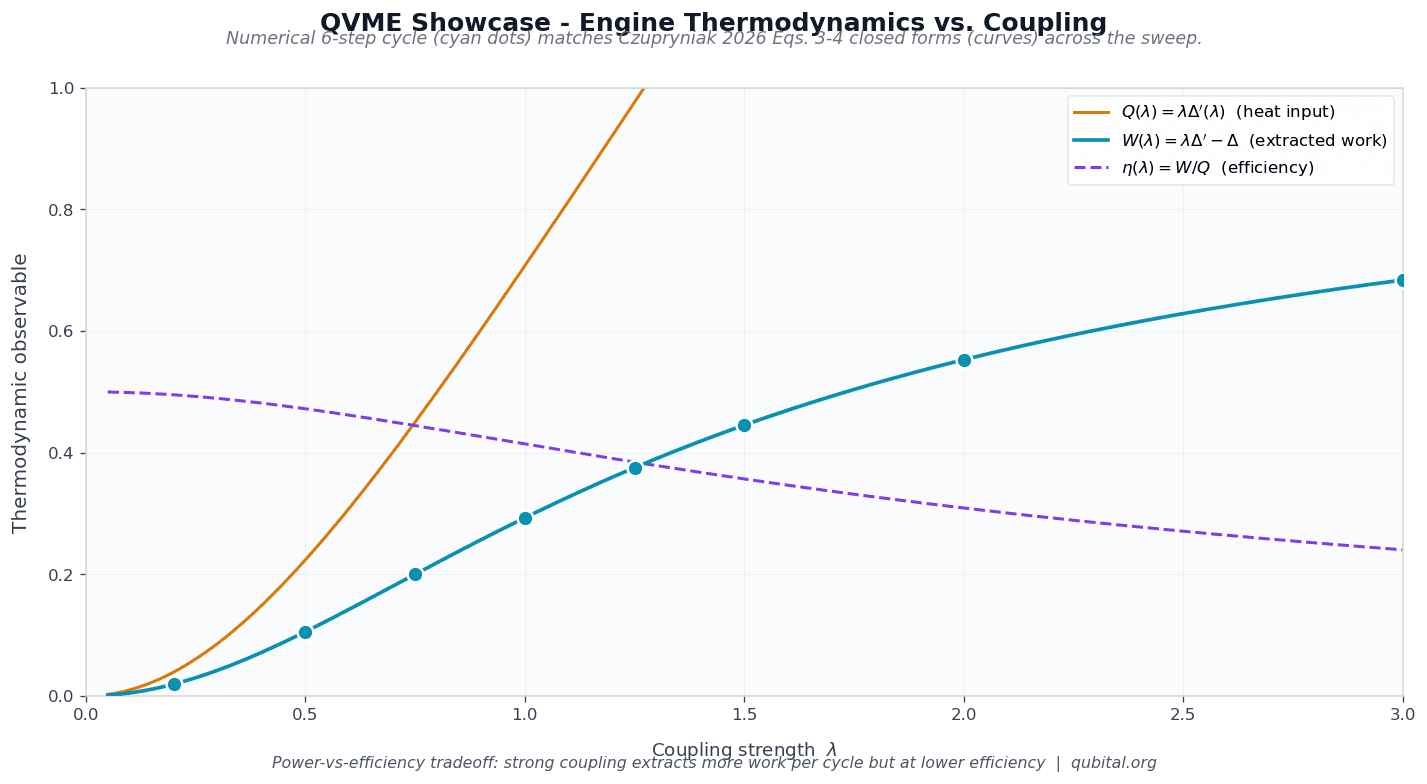
Full engine thermodynamics across the coupling sweep: work W(λ), measurement heat Q(λ), and efficiency η(λ). Numerical dots from the 8-point 6-step cycle sit exactly on the analytical curves.
[ overview ]
What this reproduces & why it matters
Czupryniak et al. (2026) — a fresh 2026 preprint from Andrew Jordan's group — defines a Quantum Vacuum Measurement Engine (QVME): a genuine thermodynamic engine that extracts work from the coupling-induced deformation of a quantum many-body ground state.
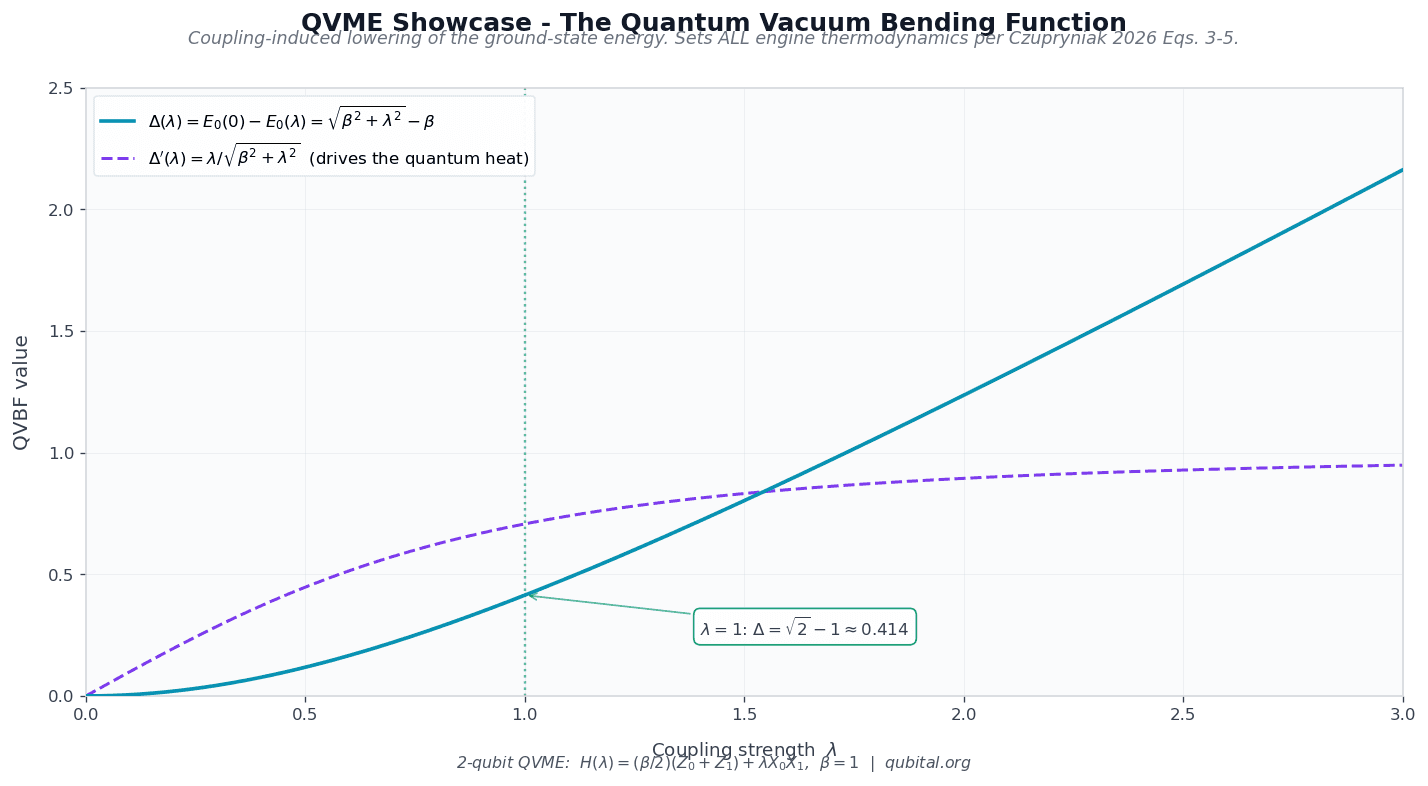
Every thermodynamic scalar of the engine — work per cycle W, measurement heat input Q, efficiency η — is a derivative of a single geometric quantity: the Quantum Vacuum Bending Function Δ(λ) = E₀(0) − E₀(λ). This showcase reproduces the paper's 2-qubit worked example end-to-end and demonstrates the full 6-step engine cycle.
[ verified results ]
Every number below is [PASS]-checked in source.
| VQE ground state error vs. −√(β² + λ²) every coupling in the sweep | < 10⁻⁶ |
| Canonical benchmark W(1) numerical vs. analytical W_num = +0.29295, W_ana = +0.29289 | 6 × 10⁻⁵ error |
| Coupling sweep pass rate tolerance 10⁻³, all points | 8/8 PASS |
| Analytical efficiency η(1) | 41.4% |
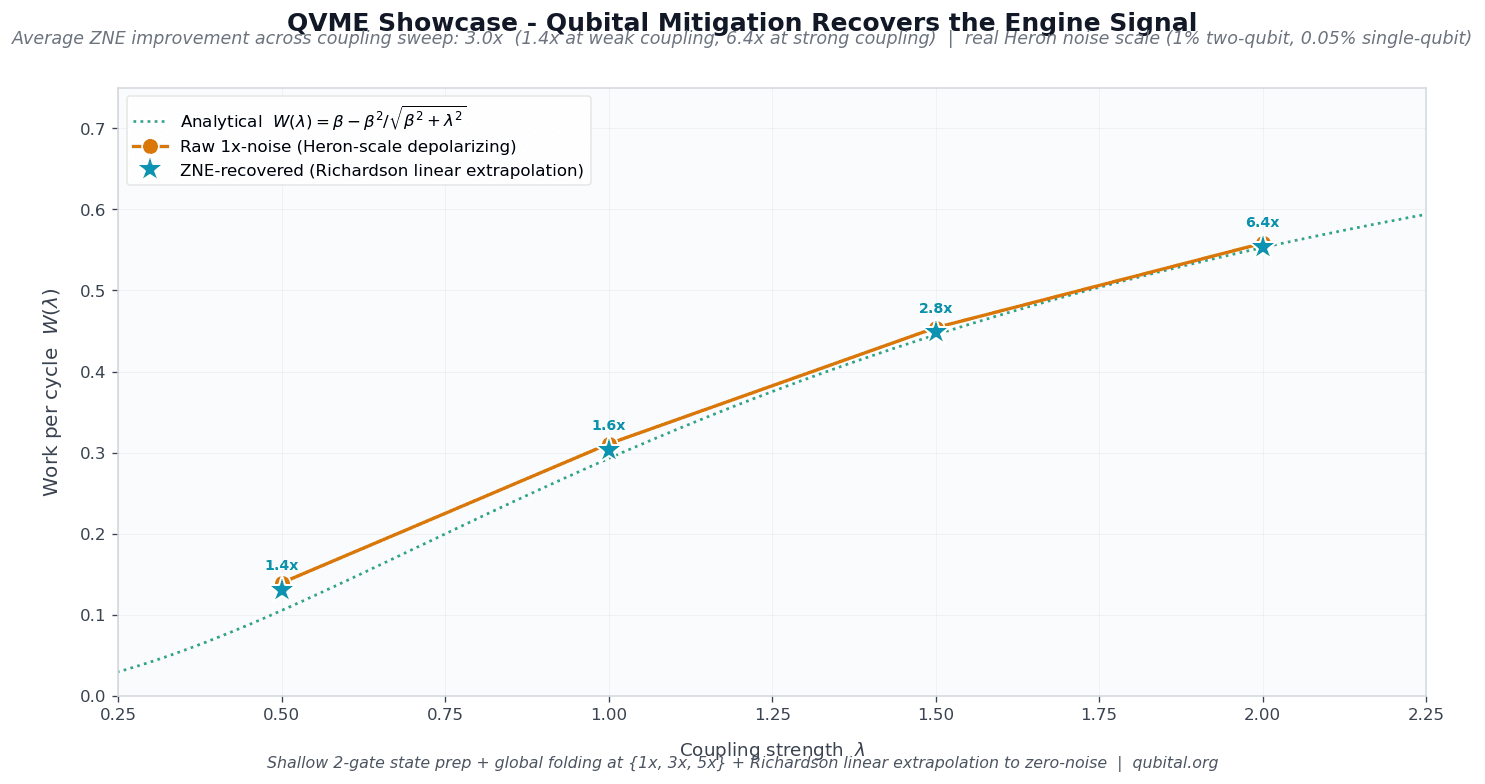
| ZNE mitigation improvement (avg over sweep) up to 6.4× at strong coupling | 3.0× |
[ method ]
How it's built
Hamiltonian H(λ) = (β/2)(Z₀ + Z₁) + λ · X₀X₁ (paper Sec. II worked example). Ground state via VQE with a parity-preserving RY + CX ansatz — the same 2-qubit subspace where H₂ lives (see Showcase #5). Full 6-step cycle: init → Z-basis measurement → quench λ off → coherent work extraction → quench λ on → thermal relaxation.
Coupling sweep at 8 points from λ = 0.2 to λ = 3.0 verifies numerical work per cycle against the closed-form W(λ) = β − β²/√(β² + λ²).
[ circuit ]
The actual Qiskit circuit

Schematic dynamic-circuit implementation of the 6-step engine cycle: init |0(λ)⟩ → Z-basis measure → quench off → conditional work extraction → quench on → relax.
[ figures ]
Physics visuals
[ mitigation ]
What Qubital's ZNE buys you here
[ references ]
Papers & sources
- Czupryniak, R., Bhandari, B., Erdman, P. A., Jordan, A. N. (2026). "Universal Characterization of Quantum Vacuum Measurement Engines."
- Elouard, C., Herrera-Martí, D., Huard, B., Auffèves, A. (2017). "Extracting Work from Quantum Measurement in Maxwell's Demon Engines." Phys. Rev. Lett. 118, 260603.
- Bhandari, B., Czupryniak, R., Erdman, P. A., Jordan, A. N. (2023). "Measurement-Based Quantum Thermal Machines with Feedback Control." Entropy 25, 204.
[ what's next ]
Roadmap for this showcase
- Multi-cycle work extraction — chain the 6-step cycle over N iterations and verify aggregate W = N · W(λ) with drift analysis under noise
- Coupling-sweep hardware run on real Heron r2 once IBM access is restored
- Extend to the paper's 4-qubit and N-qubit variants
[ request access ]
Want to run this yourself?
The physics-showcases repo is currently private, protecting IP pre-revenue. Physicists, quantum-industry contacts, and investors: reach out and I'll set up a technical walkthrough, call, or Loom.
Request a walkthrough