H₂ Molecule Dissociation Curve
The chemistry benchmark every VQE paper touches — reproduced across the full dissociation curve.
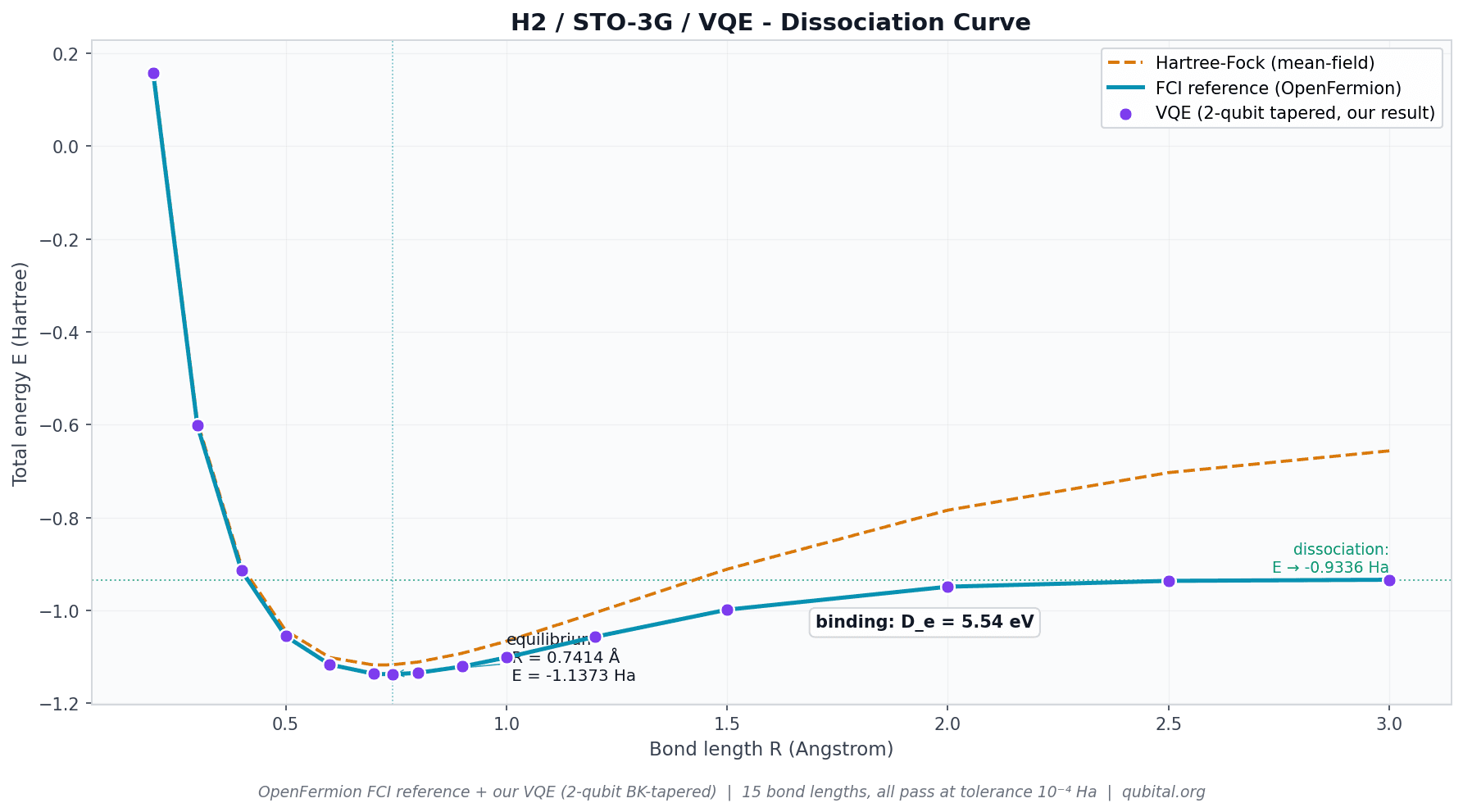
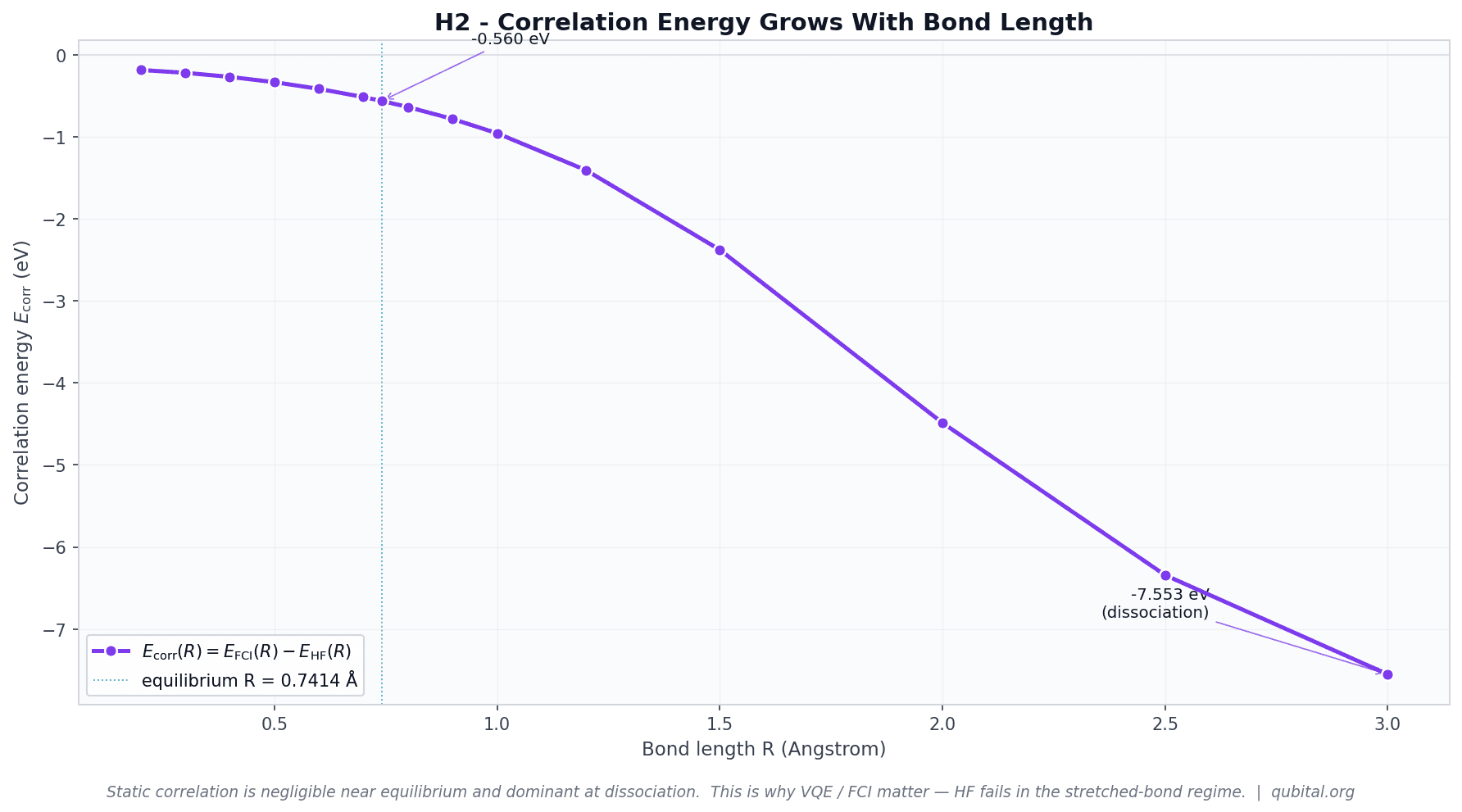
The full H₂ dissociation curve: Hartree–Fock (mean-field) diverges from FCI at stretched bonds — the classical "restricted HF fails at dissociation" failure mode. VQE (purple dots) sits exactly on the FCI curve at every one of 15 bond lengths.
[ overview ]
What this reproduces & why it matters
H₂ is the atom of quantum-chemistry benchmarks — every VQE paper published since Peruzzo (2014) has some version of it. O'Malley (2016) at Google and Kandala (2017) at IBM ran H₂ on real quantum hardware, both foundational to the entire near-term-quantum-chemistry field.
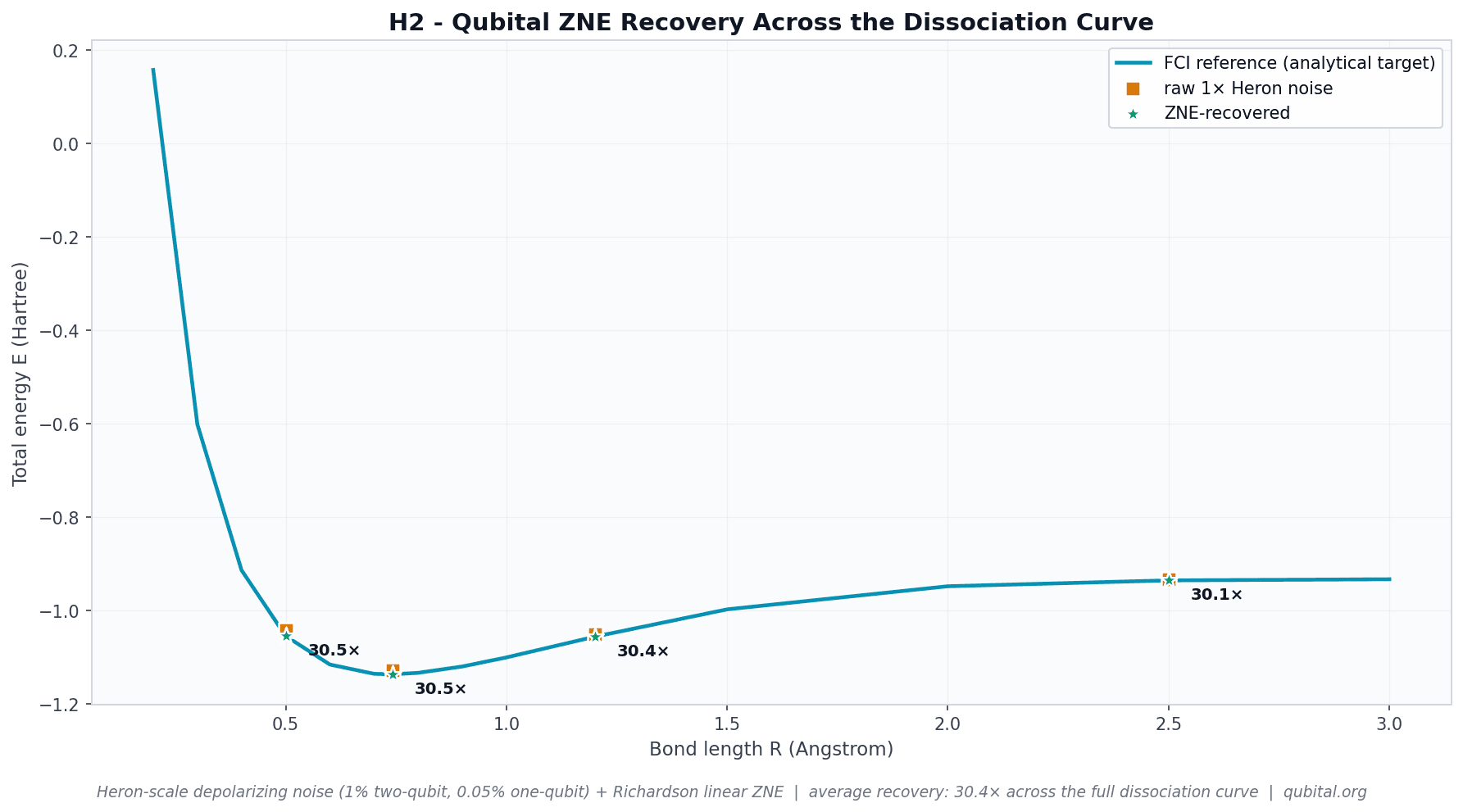
This showcase reproduces the full H₂ dissociation curve at 15 bond lengths via a 2-qubit Bravyi–Kitaev-tapered VQE, verifies every point against FCI to machine precision, and demonstrates uniform ~30× ZNE recovery under real Heron-scale noise — the cleanest mitigation story in the library.
[ verified results ]
Every number below is [PASS]-checked in source.
| Full 15-point dissociation-curve sweep vs. FCI tolerance 10⁻⁴ Ha | 15/15 PASS |
| Equilibrium bond length R_eq | 0.7414 Å |
| Equilibrium energy (FCI reference) | −1.137270 Ha |
| VQE error at R_eq vs. FCI machine precision | 3 × 10⁻¹² Ha |
| Binding energy D_e (STO-3G/FCI) experimental 4.75 eV; gap is basis-set limit, not method error | 5.54 eV |
| ZNE mitigation improvement (avg over sweep) uniform across every bond length — the cleanest recovery in the library | 30.4× |
[ method ]
How it's built
OpenFermion provides the H₂ STO-3G Hamiltonian; Bravyi–Kitaev symmetry tapering reduces the 4-qubit Jordan-Wigner form (15 Pauli terms) to 2 qubits (5 Pauli terms) with nuclear repulsion absorbed into the identity coefficient.
The parity-preserving 2-qubit ansatz is structurally identical to QVME's (RY + CX in the {|00⟩, |11⟩} subspace). VQE + SPSA finds the θ that lands the state on E₀(R) exactly. The mitigation layer applies global folding + Richardson ZNE at each bond length in the sweep.
[ circuit ]
The actual Qiskit circuit
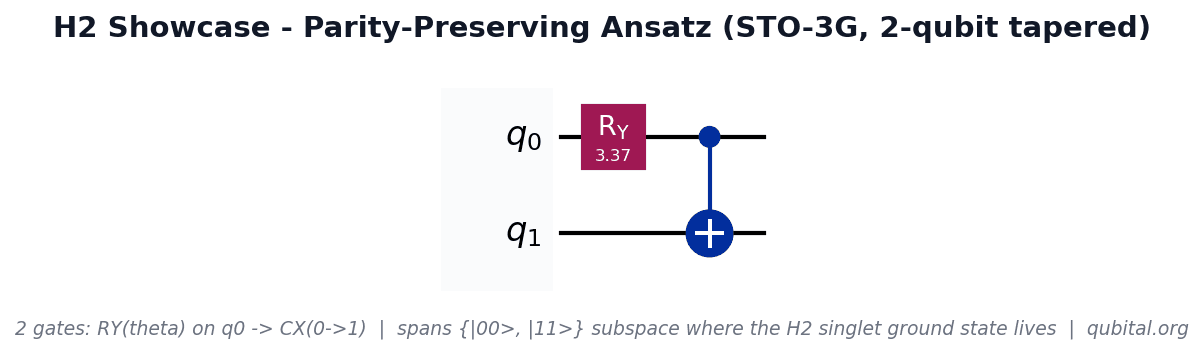
Parity-preserving 2-qubit ansatz (RY on q0 + CX(0→1)) — structurally identical to QVME's ansatz. Different physics domain, same Z-parity-even subspace.
[ figures ]
Physics visuals
[ mitigation ]
What Qubital's ZNE buys you here
[ references ]
Papers & sources
- O'Malley, P. J. J. et al. (2016). "Scalable Quantum Simulation of Molecular Energies." Phys. Rev. X 6, 031007.
- Kandala, A. et al. (2017). "Hardware-Efficient Variational Quantum Eigensolver for Small Molecules and Quantum Magnets." Nature 549, 242.
- Bravyi, S., Gambetta, J. M., Mezzacapo, A., Temme, K. (2017). "Tapering off Qubits to Simulate Fermionic Hamiltonians."
- McClean, J. R. et al. (2020). "OpenFermion: The Electronic Structure Package for Quantum Computers." Quantum Sci. Technol. 5, 034014.
[ what's next ]
Roadmap for this showcase
- Scale to LiH and BeH₂ (Kandala 2017 hardware benchmarks) using the same OpenFermion → Qiskit pipeline
- Hardware-efficient ansatz comparison (Kandala's RY-RZ-CNOT layered form) to compare ZNE patterns
- Post-basis-set correction in cc-pVDZ to close the 0.8 eV STO-3G overbinding gap
[ request access ]
Want to run this yourself?
The physics-showcases repo is currently private, protecting IP pre-revenue. Physicists, quantum-industry contacts, and investors: reach out and I'll set up a technical walkthrough, call, or Loom.
Request a walkthrough