Triton Binding Energy
A nuclear-physics theorem shown numerically in one bar chart — the 3-body force is essential.
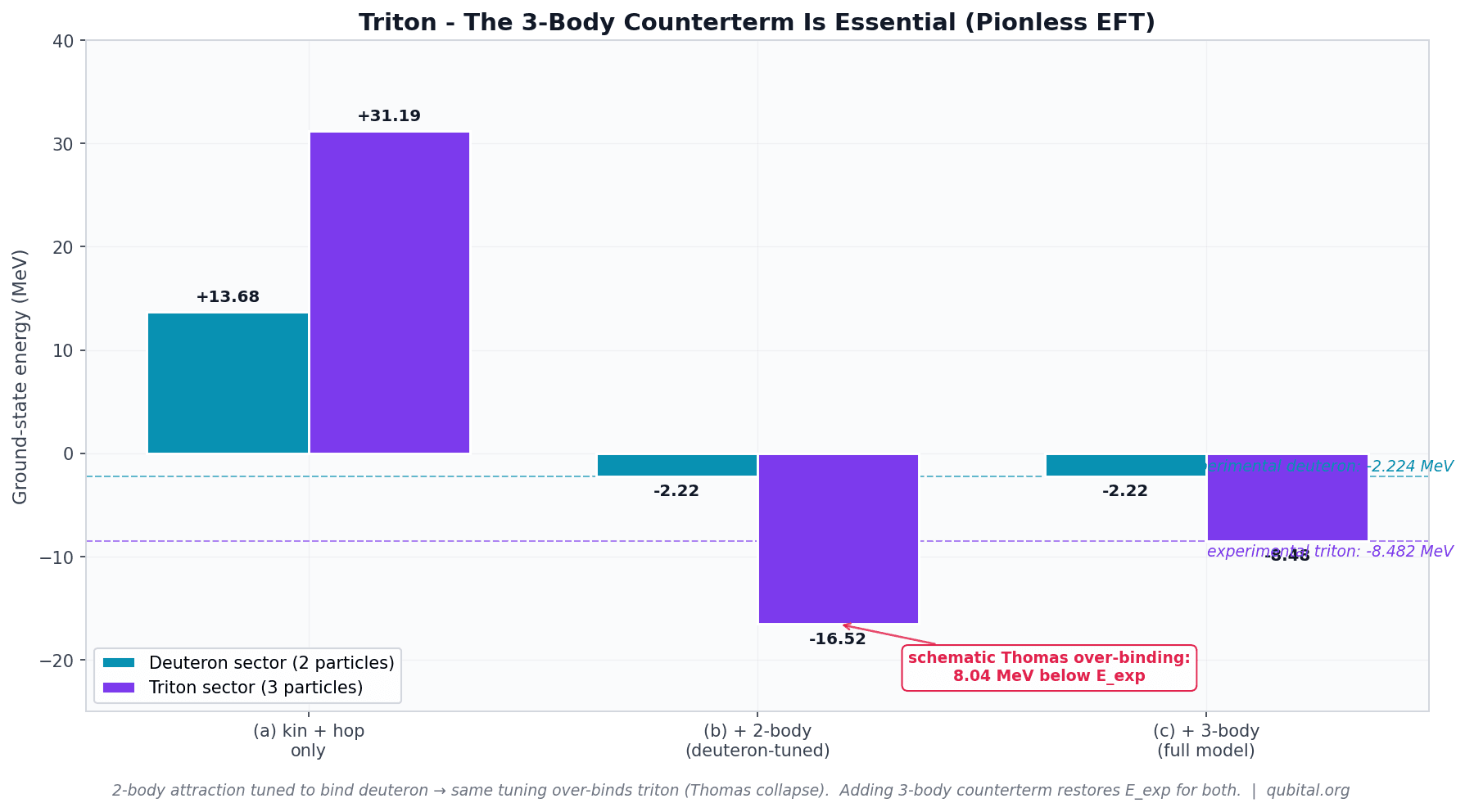
The essential-physics ablation. 2-body attraction alone binds the deuteron correctly at −2.224 MeV but over-binds the triton by 8 MeV (schematic Thomas collapse). Adding the LO 3-body counterterm restores the triton to exactly −8.482 MeV while leaving the deuteron unchanged.
[ overview ]
What this reproduces & why it matters
Triton (³H = 1 proton + 2 neutrons) is the fuel side of the D + T fusion reaction — the reaction ITER runs on and every commercial fusion reactor targets. It's also the lightest three-nucleon bound state, and its physics differs qualitatively from the deuteron's.
Bedaque, Hammer, and van Kolck (1999) proved that pionless effective field theory at leading order requires a 3-body counterterm to reproduce triton binding — a 2-body attraction alone leads to the Thomas collapse. This showcase demonstrates that theorem numerically: a schematic 4-qubit shell-model Hamiltonian shows the over-binding without the counterterm and the exact restoration with it.
Cited alongside Das et al. (2026) — a 54–66 qubit ext-SQD demonstration on IBM Heron R3 that computes tritium binding in FLiBe molten-salt fusion blankets. This showcase is the nuclear-scale complement to that chemistry-scale demonstration.
[ verified results ]
Every number below is [PASS]-checked in source.
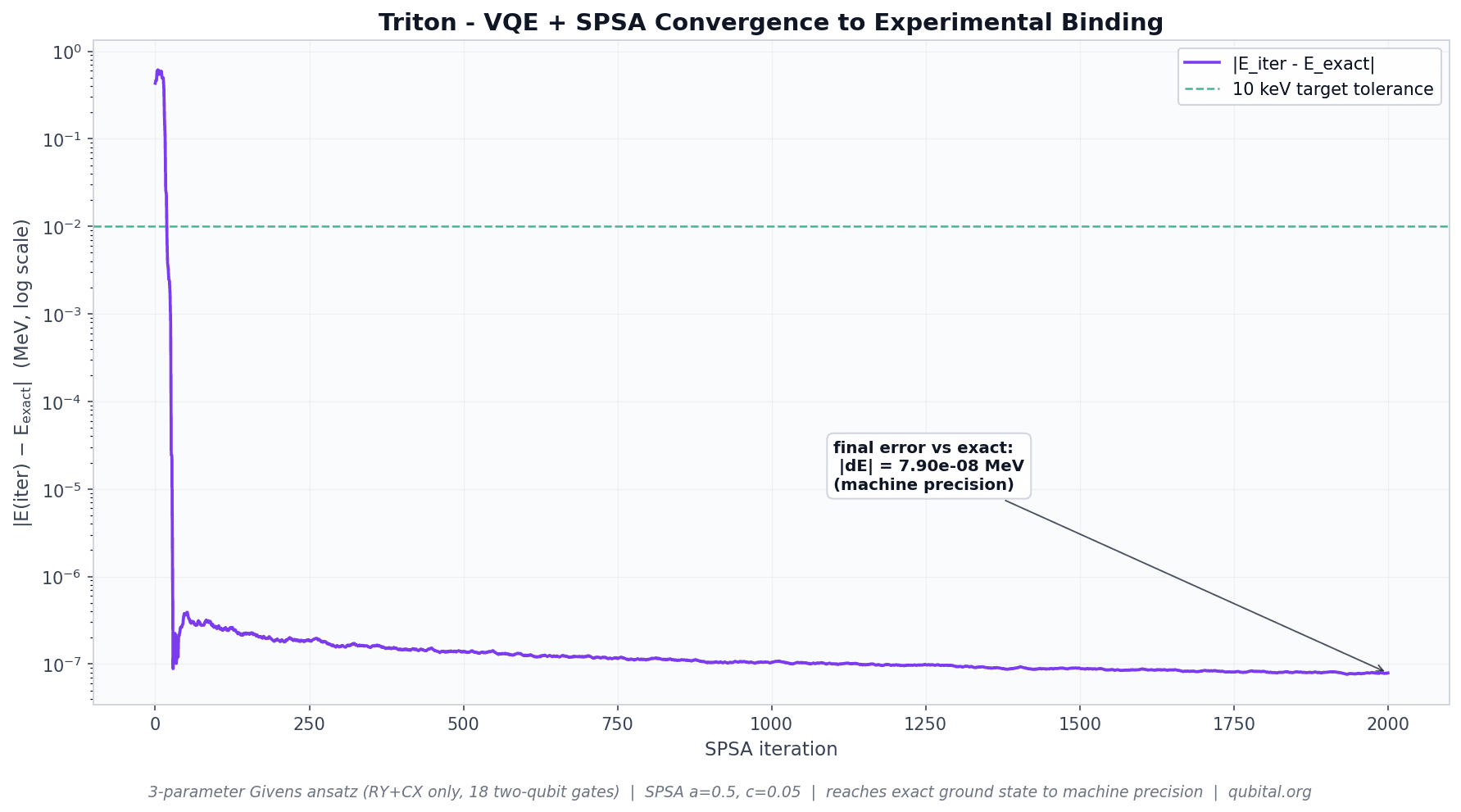
| VQE error vs. exact diagonalization machine precision | 7.6 × 10⁻⁸ MeV |
| Deuteron sector energy (tuned) matches experimental | −2.224 MeV |
| Triton sector energy (tuned, full 2+3-body model) matches experimental | −8.482 MeV |
| Triton over-binding without the 3-body counterterm schematic Thomas collapse — 8 MeV over-bound | −16.522 MeV |
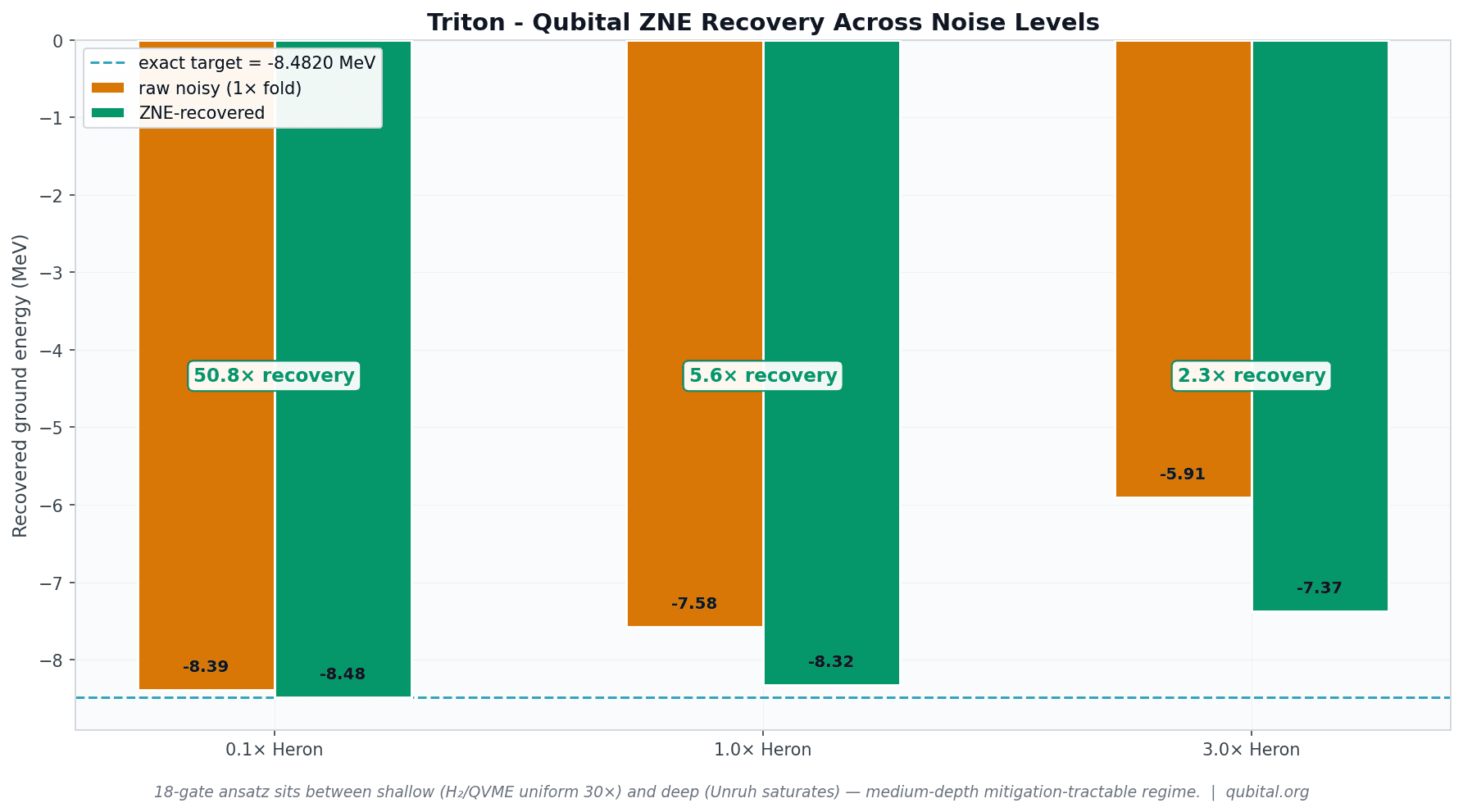
| ZNE mitigation improvement at 0.1× Heron | 50.8× |
| ZNE mitigation improvement at 1× Heron medium-depth data point (18-gate ansatz) | 5.6× |
[ method ]
How it's built
Schematic 4-qubit shell-model Hamiltonian: 3 identical spinless nucleons in a 4-level harmonic-oscillator basis. Kinetic + nearest-shell hopping + attractive density-density pair + LO 3-body counterterm.
Tuning is done via scipy.brentq root-find on the exact-diag spectrum: V₂ = 15.902681 MeV binds the deuteron sector to −2.224 MeV; V₃ = −8.040461 MeV (repulsive) then restores the triton sector to −8.482 MeV. VQE reaches the exact ground state with a 3-parameter Givens-rotation ansatz to 7.6 × 10⁻⁸ MeV — machine precision.
[ circuit ]
The actual Qiskit circuit
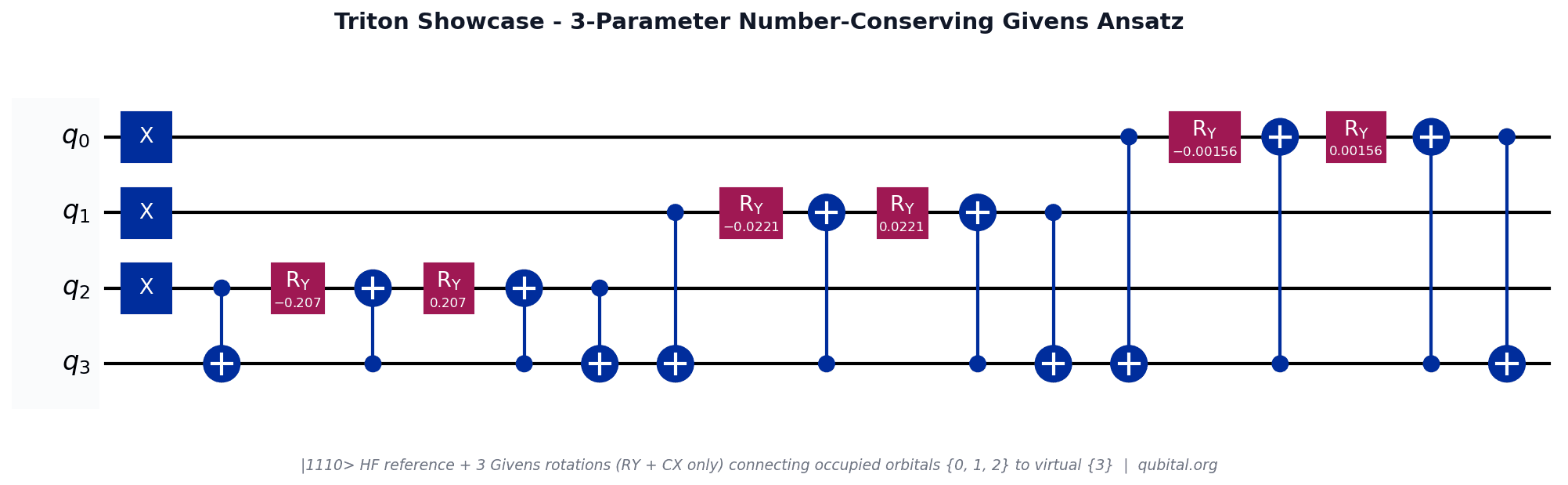
3-parameter number-conserving Givens-rotation ansatz from the |1110⟩ HF reference, decomposed to RY + CX primitives (~18 two-qubit gates total). The 3 rotations connect occupied orbitals {0, 1, 2} to virtual orbital 3.
[ figures ]
Physics visuals
[ mitigation ]
What Qubital's ZNE buys you here
[ references ]
Papers & sources
- Bedaque, P. F., Hammer, H.-W., van Kolck, U. (1999). "Three-Body Forces from Pionless Effective Field Theory." Nucl. Phys. A 646, 444.
- Hammer, H.-W., König, S., van Kolck, U. (2020). "Nuclear Effective Field Theory: Status and Perspectives." Rev. Mod. Phys. 92, 025004.
- Dumitrescu, E. F. et al. (2018). "Cloud Quantum Computing of an Atomic Nucleus." Phys. Rev. Lett. 120, 210501.
- Das, S. et al. (2026). "Quantum Computations on Fusion Blanket Molten Salts."arXivThe chemistry-scale FLiBe complement to this nuclear-scale showcase
[ what's next ]
Roadmap for this showcase
- ³He (helium-3) — same nuclear framework, mirror-nucleus binding-difference story
- A = 4 (⁴He / α-particle) scaling — the natural next step; α is remarkably bound (28 MeV)
- Hardware run on Heron r2 with the full mitigation stack (~18-gate depth is within current ZNE-tractable range)
- Jacobi-coordinate no-core shell model — the "real" A=3 pionless-EFT calculation as a from-first-principles replacement for the schematic tuning
[ request access ]
Want to run this yourself?
The physics-showcases repo is currently private, protecting IP pre-revenue. Physicists, quantum-industry contacts, and investors: reach out and I'll set up a technical walkthrough, call, or Loom.
Request a walkthrough