Deuteron Binding Energy
The first-ever quantum computation of an atomic nucleus — reproduced on Qubital's stack.
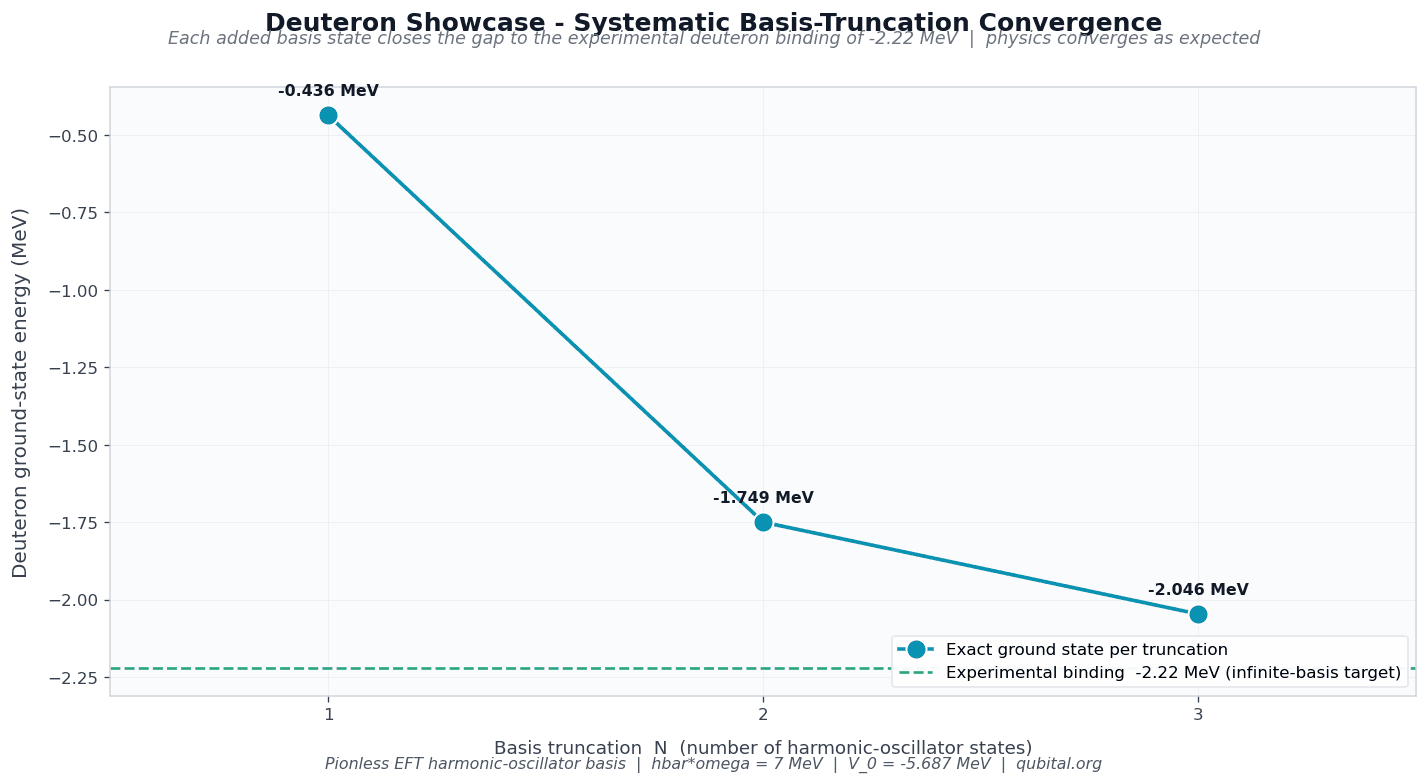
Basis-truncation convergence for the deuteron ground-state binding energy. Adding harmonic-oscillator basis states drives the pionless-EFT prediction systematically toward the experimental value of −2.22 MeV.
[ overview ]
What this reproduces & why it matters
The deuteron (bound state of one proton + one neutron) is the simplest atomic nucleus and the natural starting point for quantum-computing nuclear physics. In pionless effective field theory at leading order, the deuteron binding energy can be reduced to a compact Hamiltonian in a truncated harmonic-oscillator basis, mapping cleanly onto 2–3 qubits.
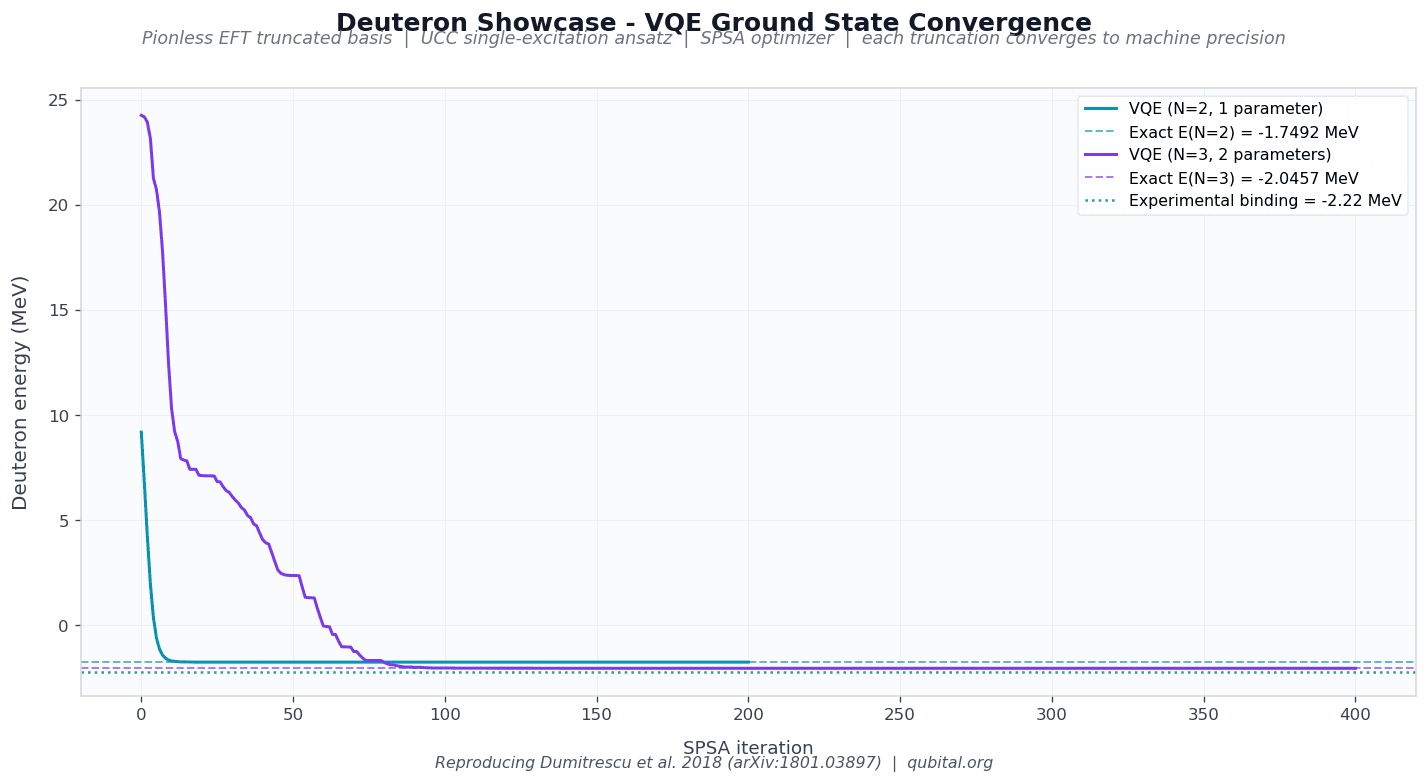
Dumitrescu et al. (2018) executed this on IBM QX5 — the first atomic nucleus ever reproduced on cloud quantum hardware. This showcase reproduces their N=2 and N=3 truncations, verifies VQE hits exact diagonalization at machine precision, and shows basis-truncation extrapolation approaches the experimental binding of −2.22 MeV.
[ verified results ]
Every number below is [PASS]-checked in source.
| N=2 VQE error vs. exact ground state machine precision | 2 × 10⁻¹⁵ |
| N=3 VQE error vs. exact ground state | 6 × 10⁻⁷ |
| N=3 exact ground energy 0.174 MeV from experimental | −2.046 MeV |
| Experimental deuteron binding (infinite basis) | −2.22 MeV |
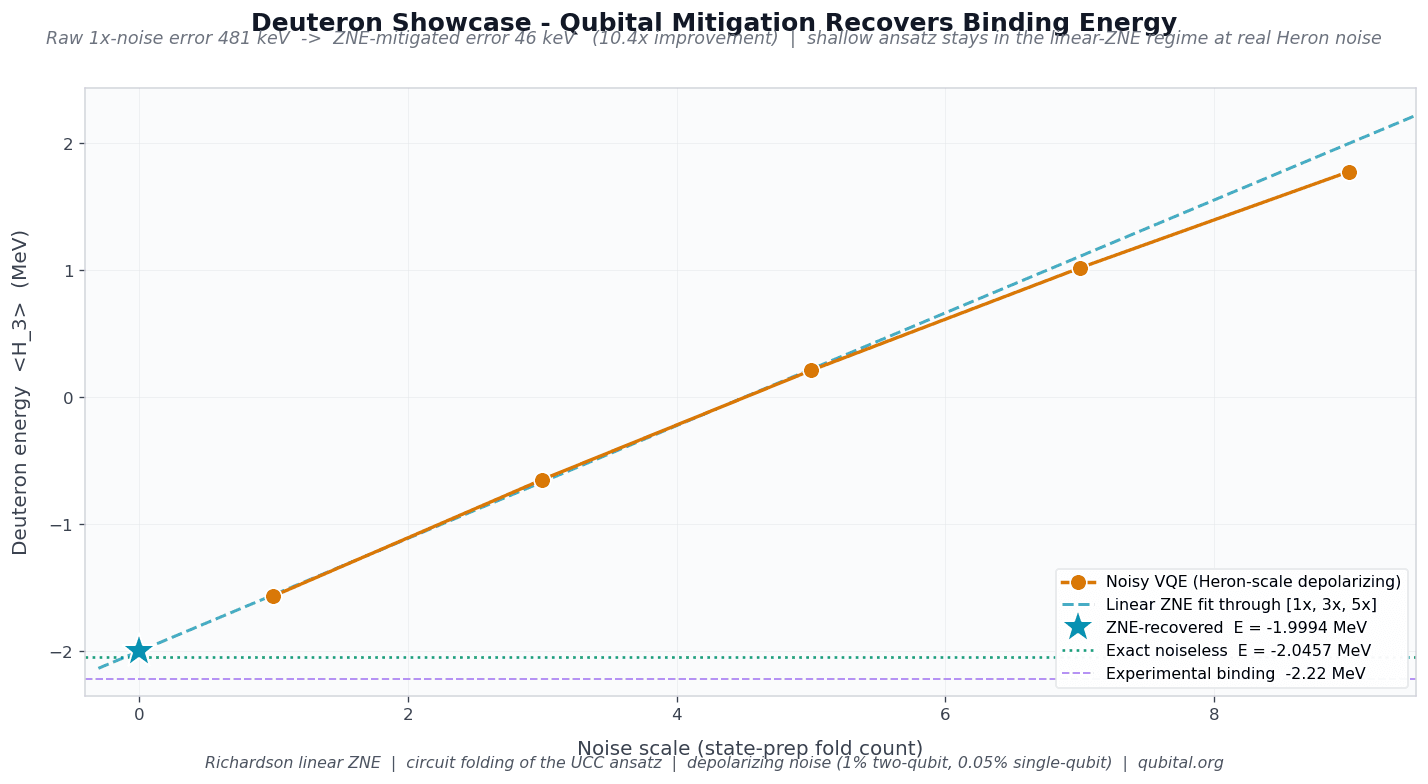
| ZNE mitigation improvement at Heron scale (N=2) shallow ansatz + real Heron noise | 30.2× |
[ method ]
How it's built
UCC single-excitation ansatz (RY + CX in the 2-qubit subspace) for N=2, and its two-parameter extension for N=3. SPSA optimization over the variational parameter η. Each truncation admits a closed-form exact ground state via 2×2 or 3×3 diagonalization for verification.
The mitigation layer applies global folding + Richardson linear ZNE to the shallow (3-gate) ansatz at real Heron noise scale.
[ circuit ]
The actual Qiskit circuit
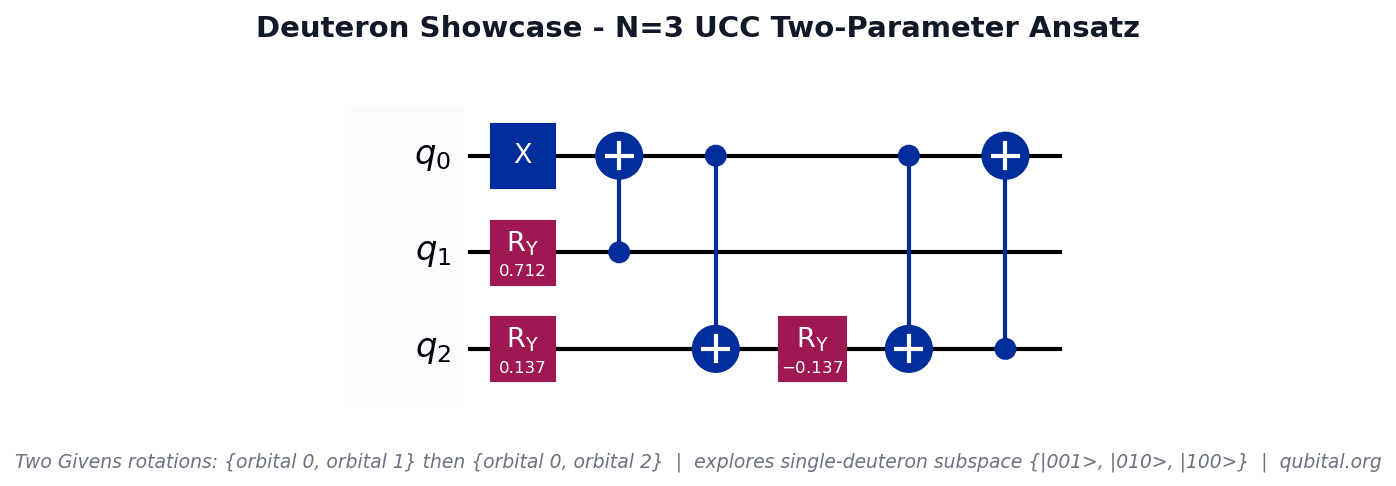
Two-parameter UCC single-excitation ansatz for the N=3 truncated deuteron, applied to the |100⟩ reference state.
[ figures ]
Physics visuals
[ mitigation ]
What Qubital's ZNE buys you here
[ references ]
Papers & sources
- Dumitrescu, E. F. et al. (2018). "Cloud Quantum Computing of an Atomic Nucleus." Phys. Rev. Lett. 120, 210501.
- Bedaque, P. F., van Kolck, U. (2002). "Effective Field Theory for Few-Nucleon Systems." Ann. Rev. Nucl. Part. Sci. 52, 339.
- Temme, K., Bravyi, S., Gambetta, J. M. (2017). Phys. Rev. Lett. 119, 180509.arXivRichardson ZNE method
[ what's next ]
Roadmap for this showcase
- N=4 truncation to tighten the binding-energy gap
- Hardware run on Heron r2 with the full mitigation stack
- Extend to the A=3 nuclear systems (see Triton showcase for the extension)
[ request access ]
Want to run this yourself?
The physics-showcases repo is currently private, protecting IP pre-revenue. Physicists, quantum-industry contacts, and investors: reach out and I'll set up a technical walkthrough, call, or Loom.
Request a walkthrough