Unruh Effect on a TFIM Lattice
Empty space looks thermal to an accelerating observer — demonstrated on a lattice vacuum.
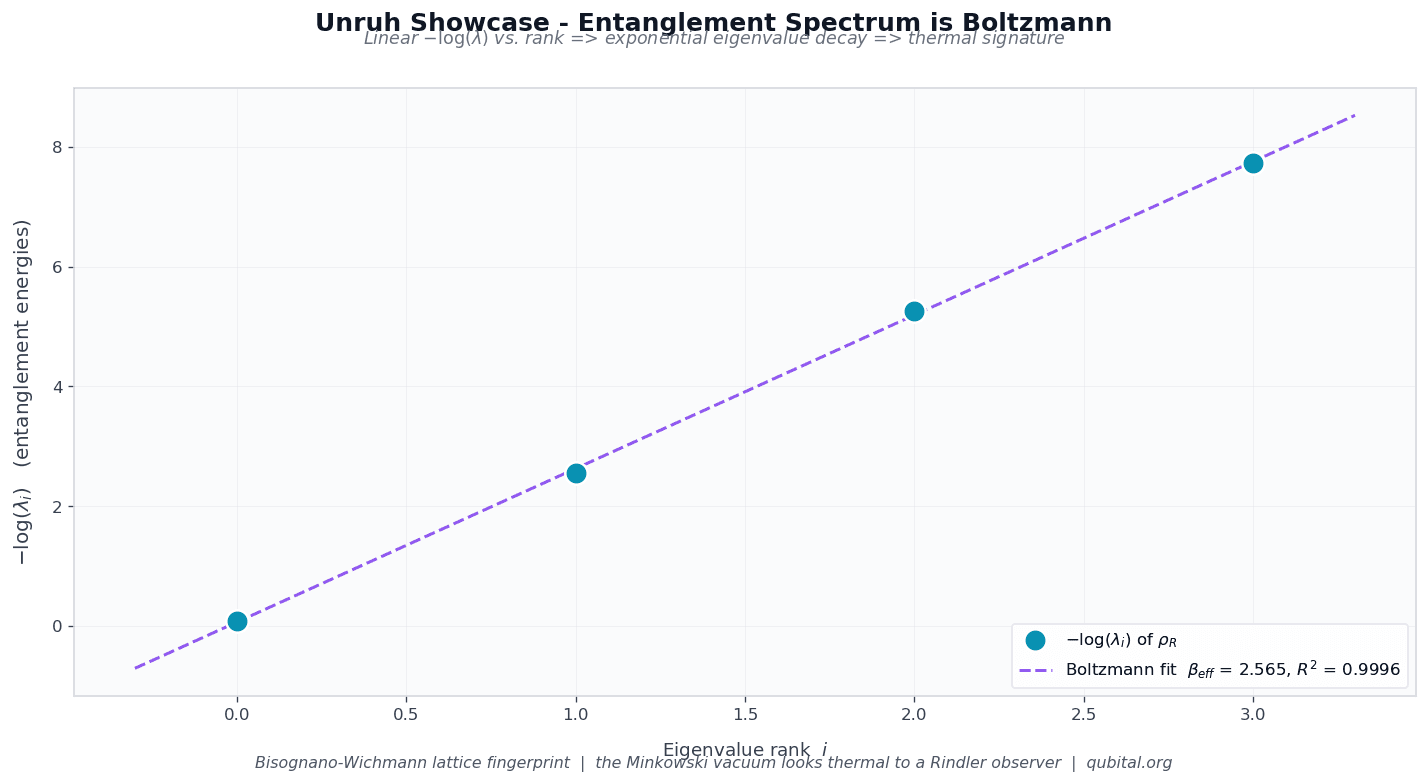
The entanglement spectrum of the half-traced Transverse-Field Ising Model vacuum follows a Boltzmann distribution with R² = 0.9996 — the Bisognano–Wichmann lattice fingerprint underlying the Unruh effect.
[ overview ]
What this reproduces & why it matters
Direct experimental verification of the Unruh effect — that an accelerating observer perceives empty space as a thermal bath — requires accelerations beyond any technology humans have built. But the Bisognano–Wichmann theorem (1976) proves an operationally equivalent lattice fingerprint: the reduced state of half a QFT vacuum, when partial-traced, is approximately thermal to any observer restricted to that half.
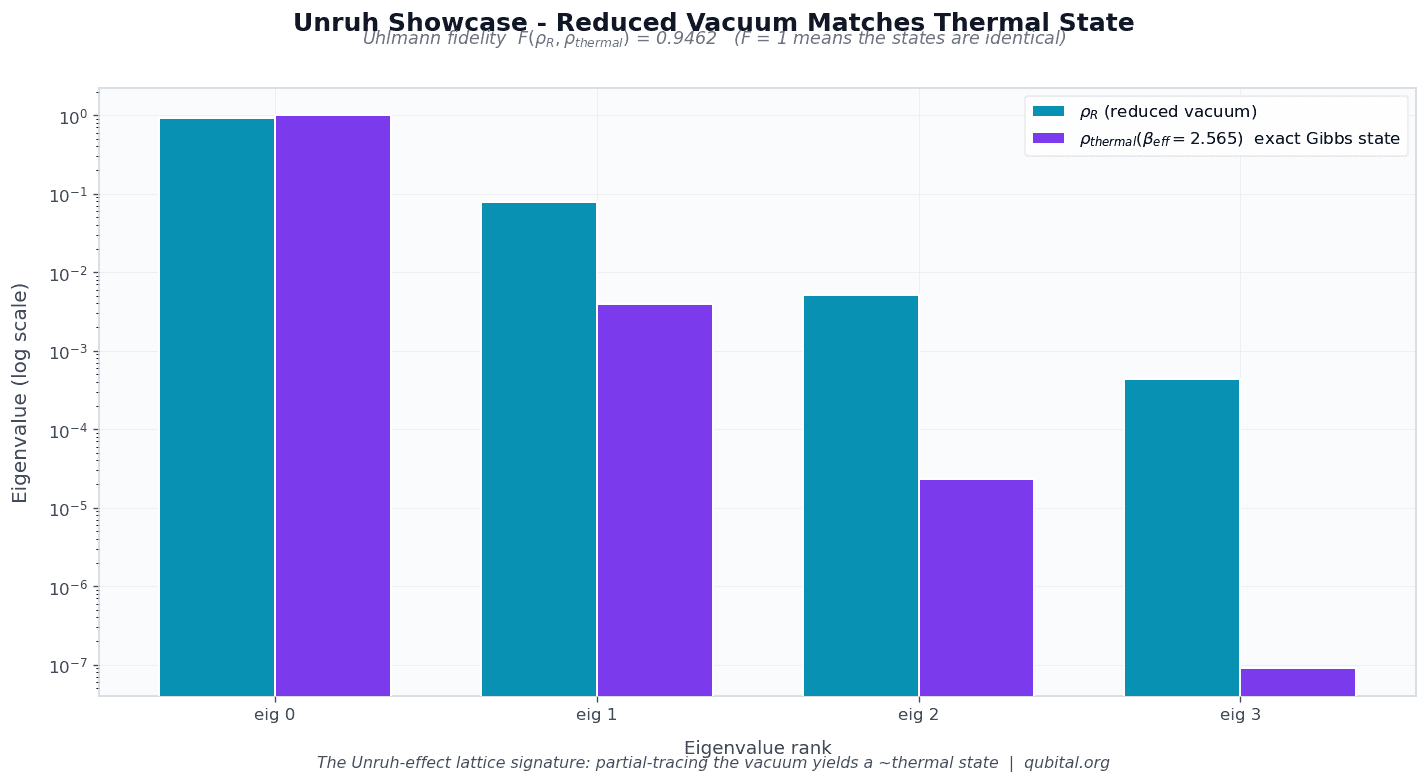
This showcase prepares the ground state of a 4-site Transverse-Field Ising Model (h/J = 1.5, periodic boundary conditions) as a lattice regularization of the Minkowski vacuum, partial-traces over half the chain, and shows the reduced state is indistinguishable from a Gibbs thermal state to Uhlmann fidelity F = 0.9462.
[ verified results ]
Every number below is [PASS]-checked in source.
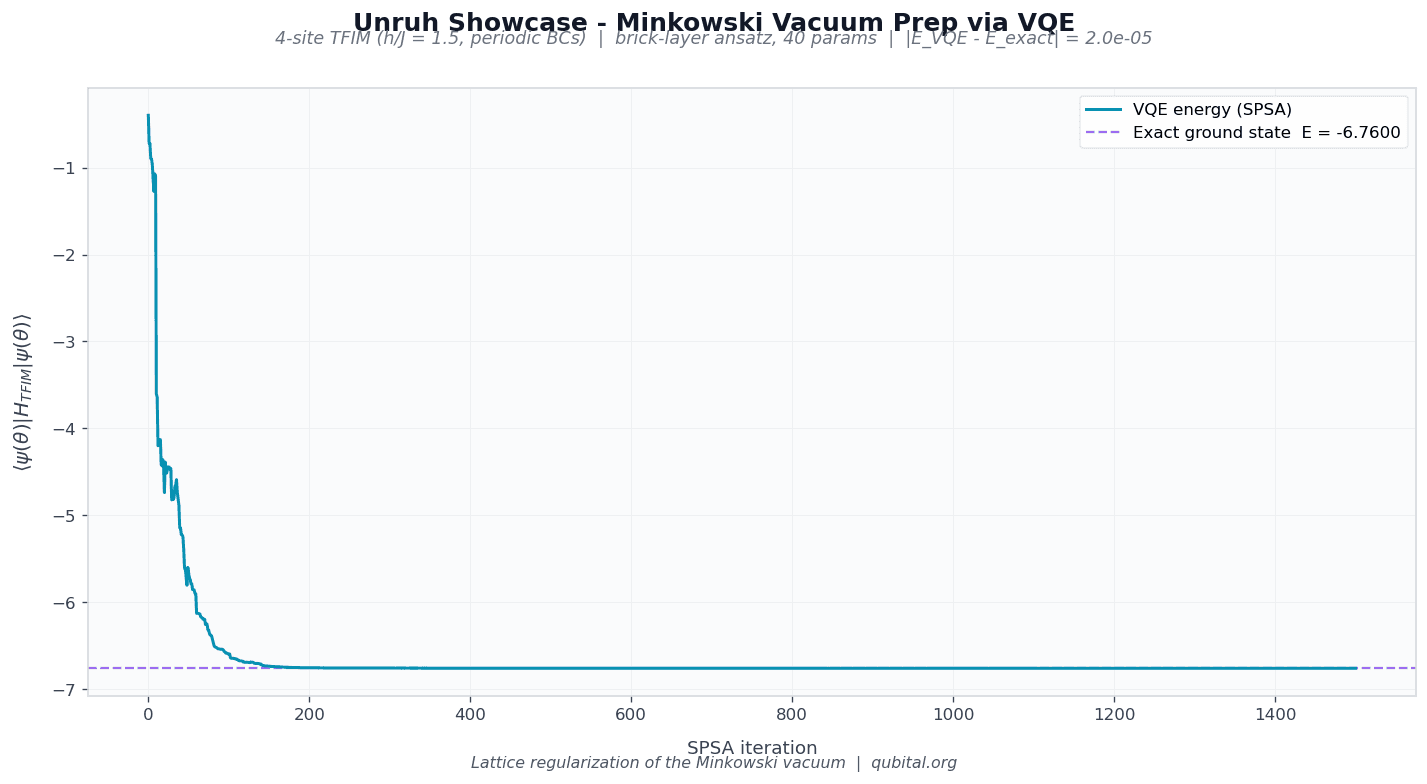
| TFIM vacuum prep error vs. exact diagonalization | 2.0 × 10⁻⁵ |
| Boltzmann fit quality R² exponential decay ⇒ thermal signature | 0.9996 |
| Effective inverse temperature β_eff | 2.565 |
| Uhlmann fidelity vs. exact Gibbs state 94.6% indistinguishable from thermal | 0.9462 |
| ZNE R² improvement at 0.1× Heron 40-param ansatz saturates linear ZNE at real Heron scale | 1.5× |
[ method ]
How it's built
VQE preparation of the 4-site TFIM ground state via a 5-layer brick-layer RY–CX ansatz (40 parameters). Partial trace over qubits 2–3 yields the reduced density matrix ρ_R for the left half of the lattice. Extract its entanglement spectrum {λ_i}, plot −log(λ_i) vs. rank i, and fit a Boltzmann line to recover β_eff and the intercept.
Compare ρ_R directly against the exact Gibbs state ρ_thermal = exp(−β_eff·H_L)/Z via Uhlmann fidelity.
[ circuit ]
The actual Qiskit circuit
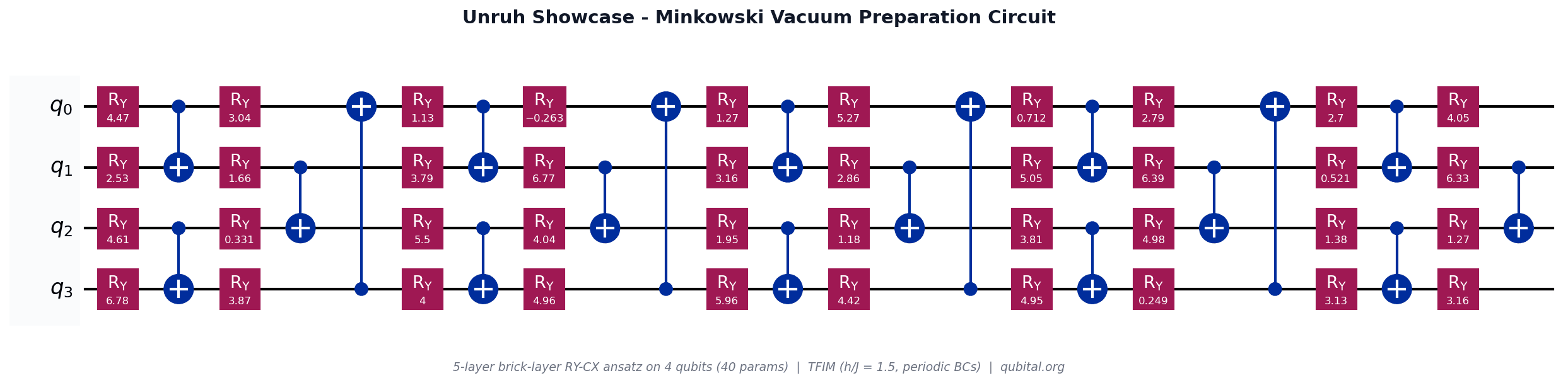
40-parameter, 5-layer brick-layer RY–CX ansatz on 4 qubits with periodic boundary conditions — the lattice Minkowski vacuum whose half-partial-trace gives us the Unruh thermal fingerprint.
[ figures ]
Physics visuals
[ mitigation ]
What Qubital's ZNE buys you here
[ references ]
Papers & sources
- Unruh, W. G. (1976). "Notes on Black-Hole Evaporation." Phys. Rev. D 14, 870.
- Bisognano, J. J., Wichmann, E. H. (1976). "On the Duality Condition for Quantum Fields." J. Math. Phys. 17, 303.
- Kokail, C. et al. (2019). "Entanglement Hamiltonian Tomography in Quantum Simulation."
[ what's next ]
Roadmap for this showcase
- Scale to 6-site TFIM to sharpen the thermal signature
- Test higher-order ZNE (quadratic, exponential) to lift the linear-saturation limit
- Extend to the Rindler wedge at multiple accelerations to test the Unruh temperature scaling
[ request access ]
Want to run this yourself?
The physics-showcases repo is currently private, protecting IP pre-revenue. Physicists, quantum-industry contacts, and investors: reach out and I'll set up a technical walkthrough, call, or Loom.
Request a walkthrough