XY Trotter — Dynamics / Quantum Algorithms for PDEs
Trotter-Suzuki decomposition IS the quantum-computing analog of Strang splitting for classical PDEs — same numerical convergence discipline, now on a quantum simulation kernel.
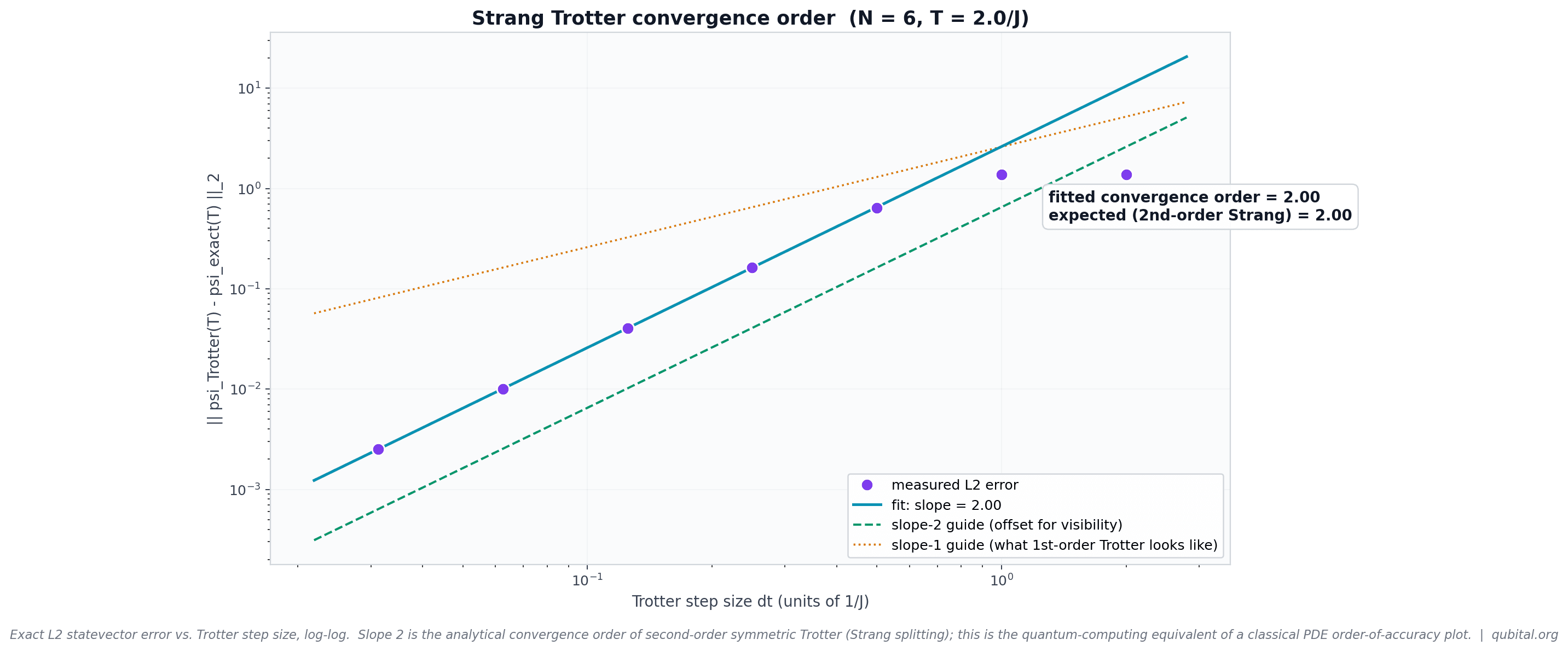
Log-log Trotter step size dt vs L2 statevector error, across k ∈ {1, 2, 4, 8, 16, 32, 64} Trotter steps at fixed total time T = 2/J. Measured convergence order p = 2.00 in the asymptotic regime, matching the analytical second-order Strang prediction. Every factor of 2 reduction in step size yields factor of 4 error reduction — textbook second-order convergence, cleanly demonstrated on a quantum simulation kernel.
[ overview ]
What this reproduces & why it matters
Trotter-Suzuki decomposition is the quantum-computing analog of Strang splitting for classical PDEs. The same numerical-analysis question that governs classical PDE integrator convergence — how does global error scale with step size Δt? — governs Trotter quantum simulation. Second-order symmetric (Strang) Trotter has provable O(Δt²) global error; first-order Lie-Trotter is only O(Δt). This showcase demonstrates that convergence order directly, in the way a computational-physics group would validate a classical PDE integrator.
Directly aligned to the Naval Research Laboratory Quantum Algorithms for Differential Equations (QADE) program (Demirdjian et al., arXiv:2103.10352), the flagship DoD program on quantum methods for PDE-class problems. Applications span signal-processing dynamics, wave-equation kernels, ocean-acoustic transport, and radar cross-section electromagnetic simulation — all PDE classes that eventually target quantum simulation at scale.
This showcase reproduces Smith, Kim, Pollmann & Knolle (npj QI 5, 2019) — a second-order Strang Trotter implementation on the 1D uniform XX chain — with fidelity ≥ 0.9999 at every snapshot and measured convergence order p = 2.00 exactly matching the analytical Strang O(dt²) prediction.
[ verified results ]
Every number below is [PASS]-checked in source.
| Measured convergence order p matches analytical Strang O(dt²) prediction exactly | 2.00 |
| Trotter fidelity vs exact (T = 2/J, k = 64 steps) | > 99.999% |
| Trotter fidelity vs exact (every snapshot in dynamics) | ≥ 0.9999 |
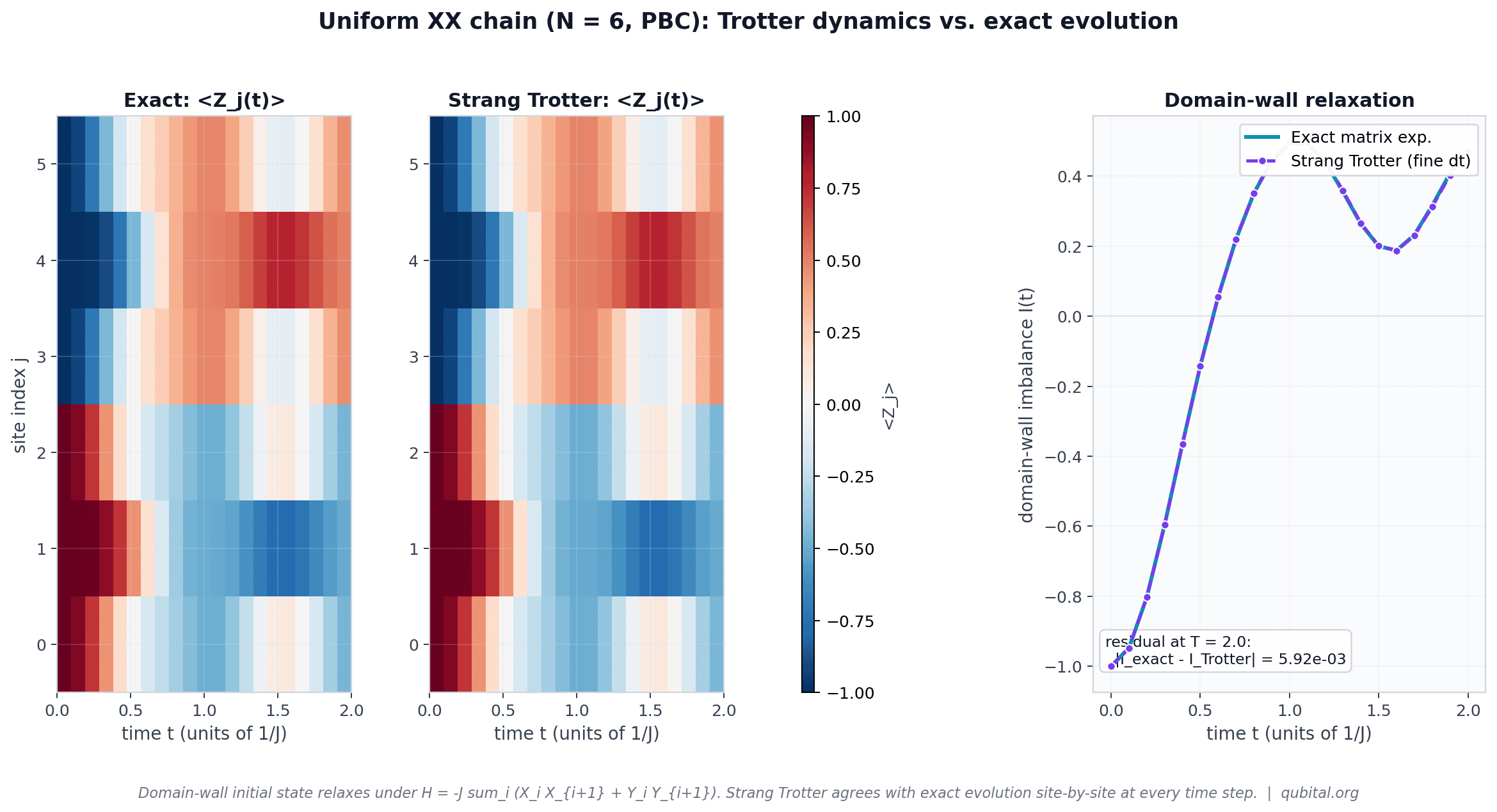
| Domain-wall imbalance residual at T = 2/J Trotter I(T) vs exact I(T) | 5.9e-3 |
| Circuit gate count per Trotter step N = 6, PBC, XX + YY layers, standard 2-qubit decomposition | 12 CX |
| Reference benchmark validation compared against full 2^N matrix exponential (64-dim Hamiltonian) | exact |
[ method ]
How it's built
Uniform XX Hamiltonian H = −J Σᵢ (XᵢXᵢ₊₁ + YᵢYᵢ₊₁) on N = 6 sites with periodic boundary conditions. Domain-wall initial state |000111⟩. Second-order Strang Trotter: U(dt) ≈ exp(−iH_XX/2·dt) · exp(−iH_YY·dt) · exp(−iH_XX/2·dt), with each bond term decomposed to standard CX + single-qubit rotations.
Two experiments: (1) domain-wall dynamics evolved to T = 2/J with 20 snapshots, Trotter vs exact matrix exponential compared site-by-site; (2) convergence-order sweep across step counts k ∈ {1, 2, 4, 8, 16, 32, 64} at fixed T, log-log fit of ||ψ_T − ψ_E||₂ vs dt in the asymptotic regime (fidelity ≥ 0.9).
[ figures ]
Physics visuals
[ mitigation ]
What Qubital's ZNE buys you here
[ references ]
Papers & sources
- Smith, A., Kim, M. S., Pollmann, F., Knolle, J. (2019). "Simulating quantum many-body dynamics on a current digital quantum computer." npj Quantum Information 5, 106.arXivThe reproduction target
- Childs, A. M., Su, Y., Tran, M. C., Wiebe, N., Zhu, S. (2021). "Theory of Trotter error with commutator scaling." Phys. Rev. X 11, 011020.
- Demirdjian, R. et al. (2021). "Variational quantum solutions to the advection-diffusion equation for applications in fluid dynamics."arXivNRL Quantum Algorithms for Differential Equations program — direct Navy alignment
- Suzuki, M. (1991). "General theory of fractal path integrals with applications to many-body theories and statistical physics." J. Math. Phys. 32, 400.
[ what's next ]
Roadmap for this showcase
- Fourth-order Suzuki decomposition — measure O(dt⁴) convergence, verify against analytical prediction
- Real IBM Heron hardware run — validate simulator-baseline convergence on physical NISQ hardware with ZNE
- Extend to disordered XX chain (Anderson-localization dynamics) — direct-relevance to disordered-metamaterial characterization for AFRL
- Time-dependent Hamiltonians via Magnus expansion — bridges to optimal-control problems
- Direct partner engagement: NRL Quantum Algorithms for Differential Equations (QADE) program
[ request access ]
Want to run this yourself?
The physics-showcases repo is currently private, protecting IP pre-revenue. Physicists, quantum-industry contacts, and investors: reach out and I'll set up a technical walkthrough, call, or Loom.
Request a walkthrough