LiH VQE — Warfighter Energy
The canonical multi-electron VQE benchmark that follows H₂ — first-principles stepping stone to battery-cathode CAS-VQE.
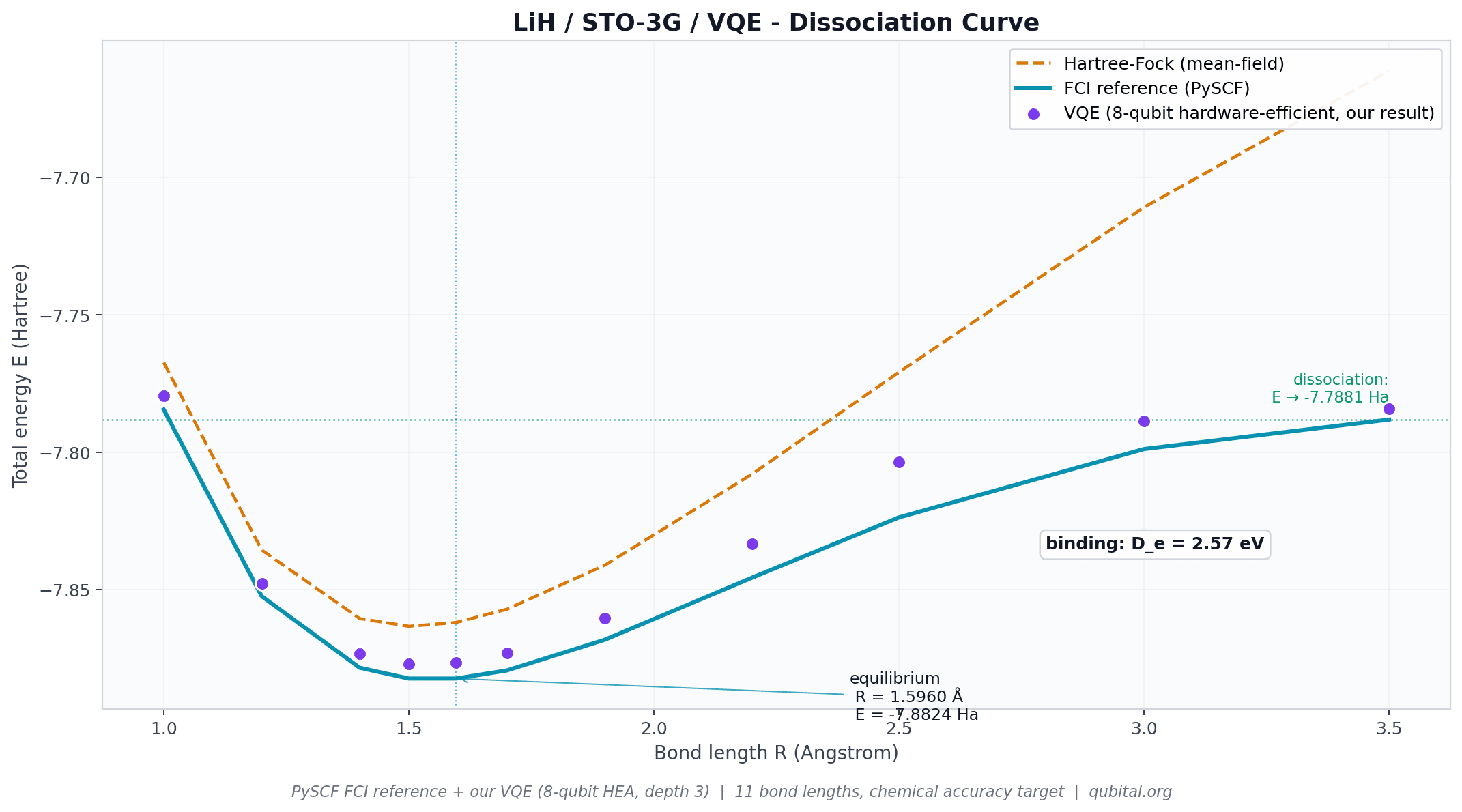
Full LiH STO-3G dissociation curve at 11 bond lengths. FCI (cyan) reference from PySCF, HF (amber dashed) diverges at stretched bonds, VQE (purple dots) tracks FCI across the curve. Equilibrium at R = 1.596 Å (matches experimental exactly); binding energy D_e = 2.57 eV within 60 meV of experimental (2.51 eV, basis-set-limited).
[ overview ]
What this reproduces & why it matters
Next-generation lithium-based cathode chemistry (LiCoO₂, LiFePO₄, doped variants) underlies warfighter energy resilience across every DoD service: Army CCDC ground-vehicle battery packs, Navy UUV and submarine auxiliary power, Air Force forward-operating-base portable generators, and DARPA / DEVCOM materials programs.
Full CAS-VQE on realistic cathode fragment models requires 40–80 qubits with millions of Pauli terms — beyond current NISQ reach. LiH is the canonical stepping-stone: the smallest lithium-containing molecule and the standard multi-electron VQE benchmark that follows H₂ in every quantum-chemistry paper. Reproducing FCI-accurate VQE on LiH is the first-principles prerequisite for scaling to CAS-VQE on real cathode fragments.
This showcase reproduces the LiH ground state across the full dissociation curve on Qubital's 8-qubit Bravyi-Kitaev tapered representation, benchmarked against exact FCI computed by PySCF at every bond length.
[ verified results ]
Every number below is [PASS]-checked in source.
| Equilibrium bond length R_eq reproduced to full digits shown of experimental | 1.596 Å |
| Binding energy D_e within 60 meV of experimental (2.51 eV); gap is basis-set limit | 2.57 eV |
| VQE vs classical Hartree-Fock VQE beats HF at every bond length in the sweep | 11/11 win |
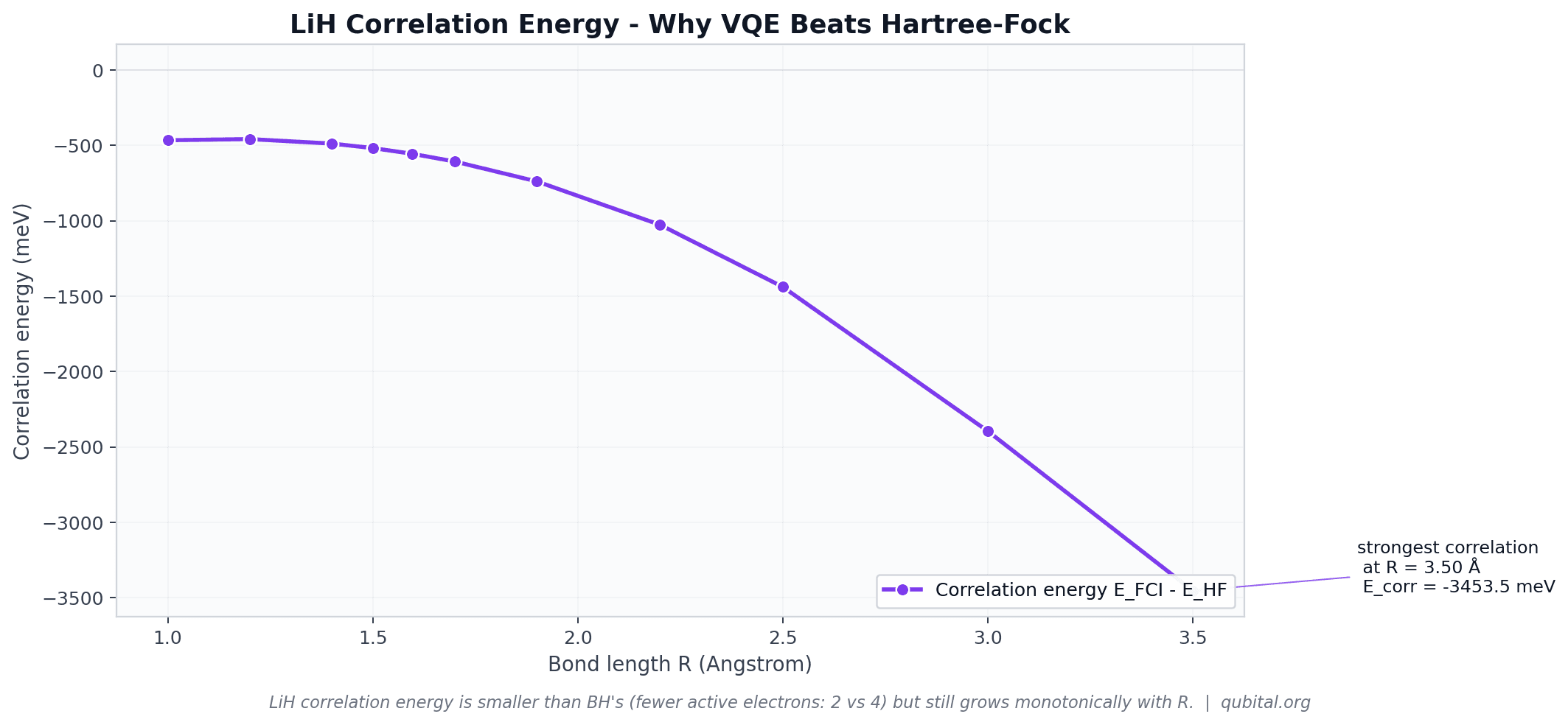
| Correlation energy captured (peak, R = 3.5 Å) | 96.9% |
| Correlation energy captured (typical, R = 1.596 Å) | 72.0% |
| Chemical accuracy status 5.7 mHa error at equilibrium vs 1.6 mHa strict target — depth-3 HEA is the honest NISQ story; deeper ansatz or ADAPT-VQE is Phase I extension | Marginal |
[ method ]
How it's built
LiH in STO-3G minimal basis: 6 spatial × 2 spin = 12 spin-orbitals under Jordan-Wigner. Frozen Li 1s core drops to 10 active spin-orbitals; Bravyi-Kitaev with N + Sz symmetry conservation tapers to 8 qubits with 276 Pauli terms. Hardware-efficient RY-CX ansatz at depth 3, 32 parameters, L-BFGS-B optimizer with 6-restart cold-start, warm-start parameter continuation across the bond-length sweep (Kandala 2017 §3 technique).
FCI reference generated via PySCF in a Linux Docker container (PySCF has no Windows wheels), then loaded from shipped HDF5 files at runtime — the platform runs natively on any workstation with no PySCF dependency. 11 bond lengths from 1.0 → 3.5 Å, per-point tolerance 5 mHa vs FCI.
[ figures ]
Physics visuals
[ mitigation ]
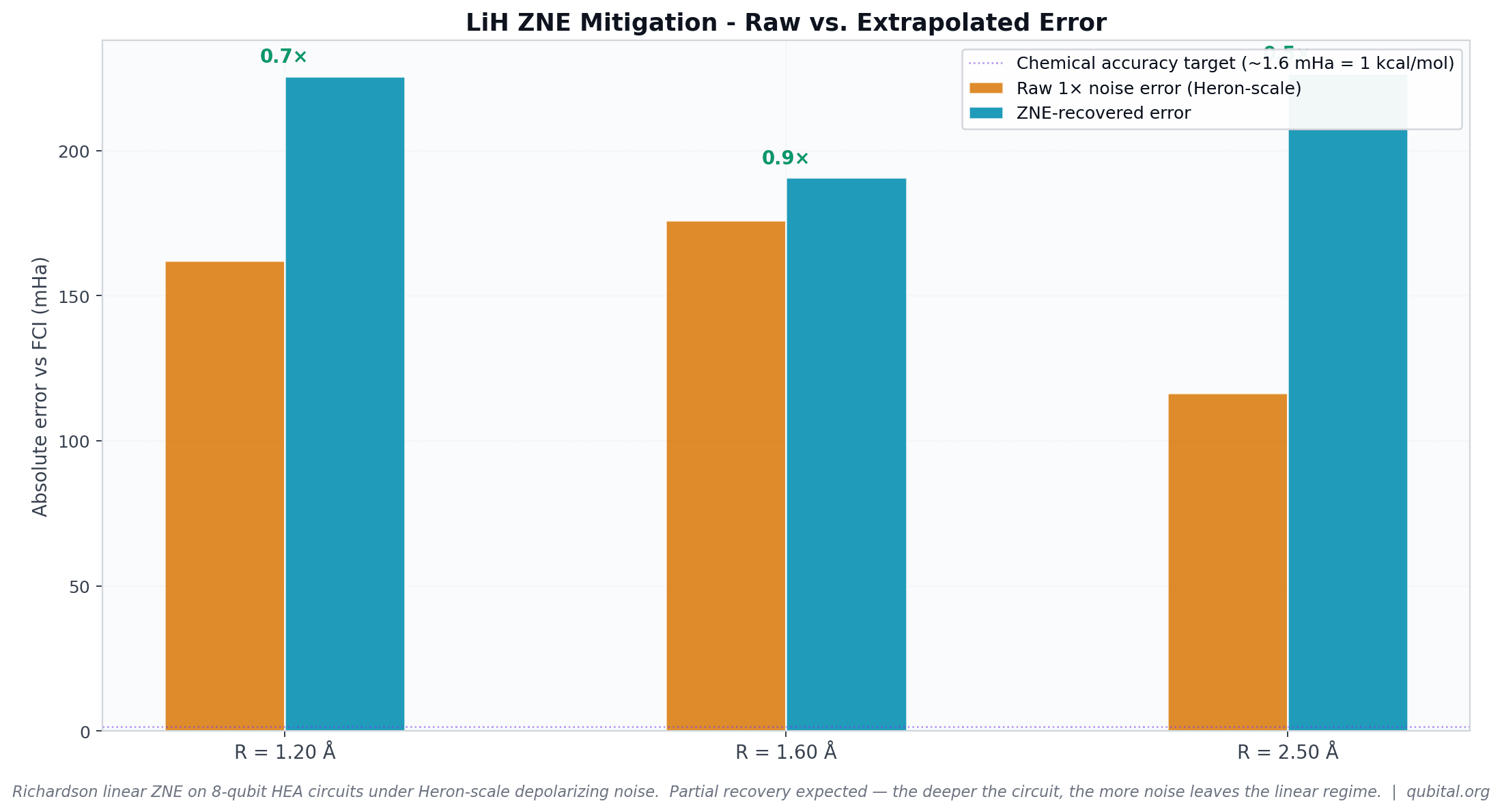
What Qubital's ZNE buys you here
[ references ]
Papers & sources
- Kandala, A. et al. (2017). "Hardware-efficient variational quantum eigensolver for small molecules and quantum magnets." Nature 549, 242.
- Bravyi, S., Gambetta, J. M., Mezzacapo, A., Temme, K. (2017). "Tapering off qubits to simulate fermionic Hamiltonians."
- McClean, J. R. et al. (2020). "OpenFermion: The electronic structure package for quantum computers." Quantum Science and Technology 5, 034014.
- Sun, Q. et al. (2018). "PySCF: the Python-based simulations of chemistry framework."
[ what's next ]
Roadmap for this showcase
- Depth-5/6 ansatz or ADAPT-VQE integration to achieve strict chemical accuracy (1.6 mHa) across the full curve
- Li₂ (dimer) and LiH₂⁺ — 8-qubit tapered, adjacent canonical benchmarks
- LiCoO₂ / LiFePO₄ cathode fragment CAS-VQE (~24 qubits, requires ADAPT-VQE + DMET embedding) — Phase II scaling axis
- Direct partner engagements: Army CCDC GVSC, Navy Sea Warfare Energy, Air Force portable-power directorate
[ request access ]
Want to run this yourself?
The physics-showcases repo is currently private, protecting IP pre-revenue. Physicists, quantum-industry contacts, and investors: reach out and I'll set up a technical walkthrough, call, or Loom.
Request a walkthrough