XY Model — quantum simulation of magnetic materials
The quantum many-body problem where classical simulation truly fails — reproduced against exact free-fermion benchmark to <1.5%.
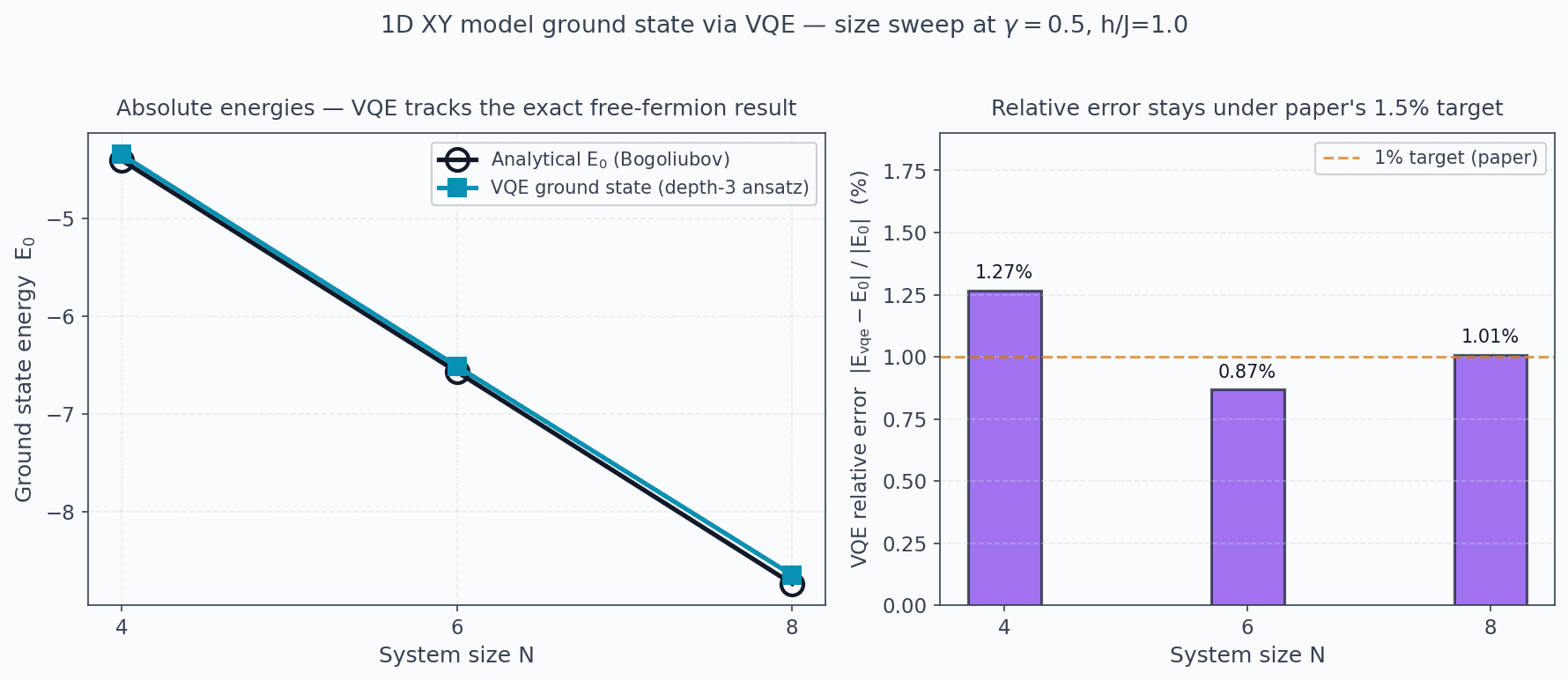
VQE ground state (cyan) tracks the exact Jordan-Wigner + Bogoliubov analytical result (black) across N = 4, 6, 8. Depth-3 hardware-efficient ansatz, 10 random restarts. Relative error stays under the paper's 1.5% target at every size. The analytical formula was validated against direct diagonalization of the 2^N Hamiltonian at 27/27 test cases to floating-point precision.
[ overview ]
What this reproduces & why it matters
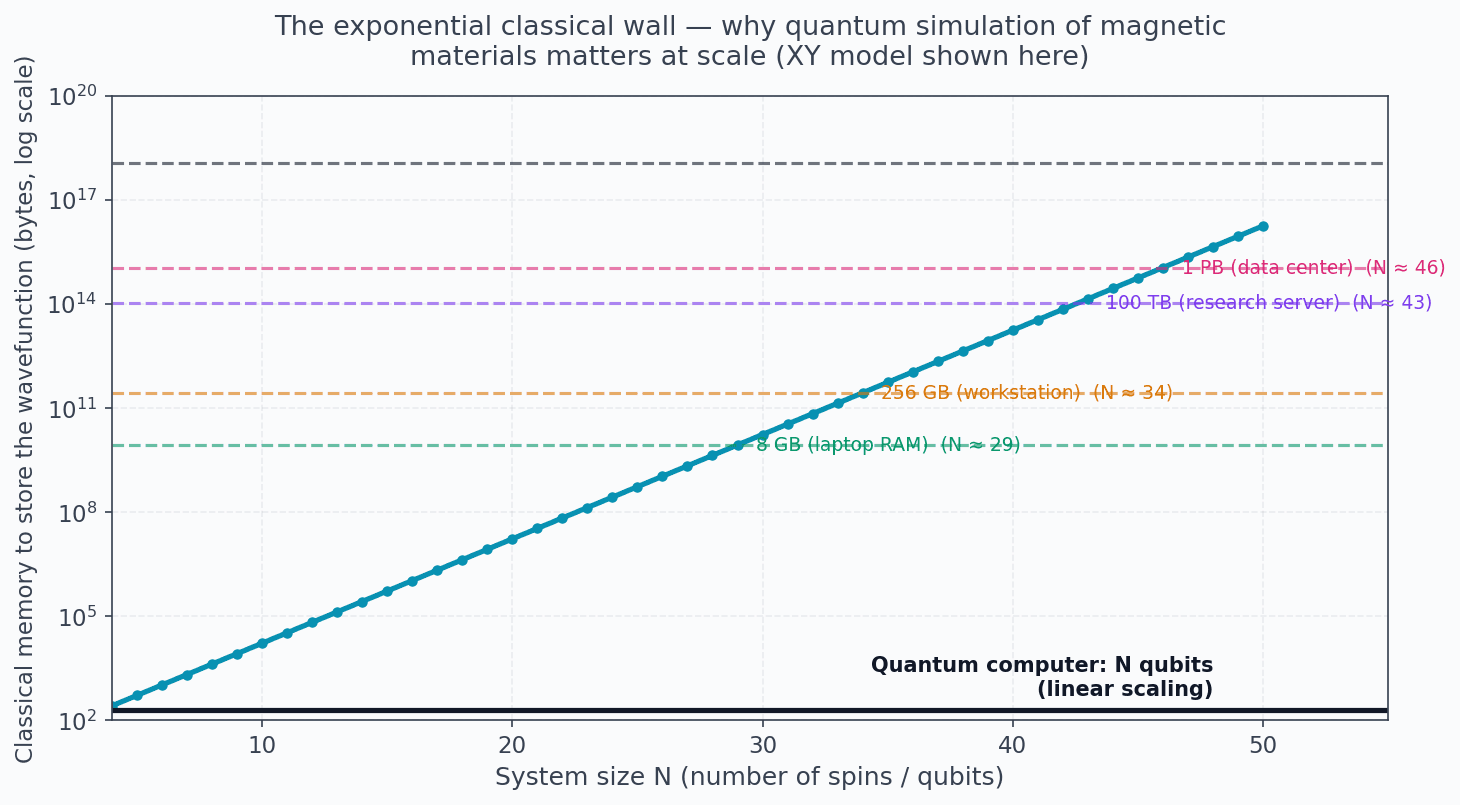
Unlike optimization benchmarks (VRP, SMPP) where classical brute-force solves the toy instance in milliseconds, the XY model exhibits the exponential classical scaling that motivates quantum computing in the first place: storing the full wavefunction of an N-site chain requires 2ᴺ complex amplitudes. At N=30 that's ~10⁹ amplitudes (~10 GB); at N=50 it exceeds all storage humanity has produced. Quantum computers store the same state in N qubits.
For this particular Hamiltonian we are lucky: the Jordan-Wigner map converts the XY model to a system of free fermions whose spectrum has a closed analytical form. That gives us the ideal benchmark — an exact classical reference at any N — while the underlying physics is the same class of Hamiltonian that governs strongly-correlated magnetic systems where classical simulation genuinely fails.
Defense relevance spans three AFRL / NASA physics regimes: (1) radar-absorbing magnetic materials for low-observable platforms, (2) quantum spin liquids underlying next-generation quantum sensors and magnetometers, and (3) the baseline Hamiltonian class from which richer defense-relevant models (2D Heisenberg, Fermi-Hubbard, Kitaev chains) are built.
[ verified results ]
Every number below is [PASS]-checked in source.
| VQE relative error at N=4 depth-3 RealAmplitudes ansatz | 1.27% |
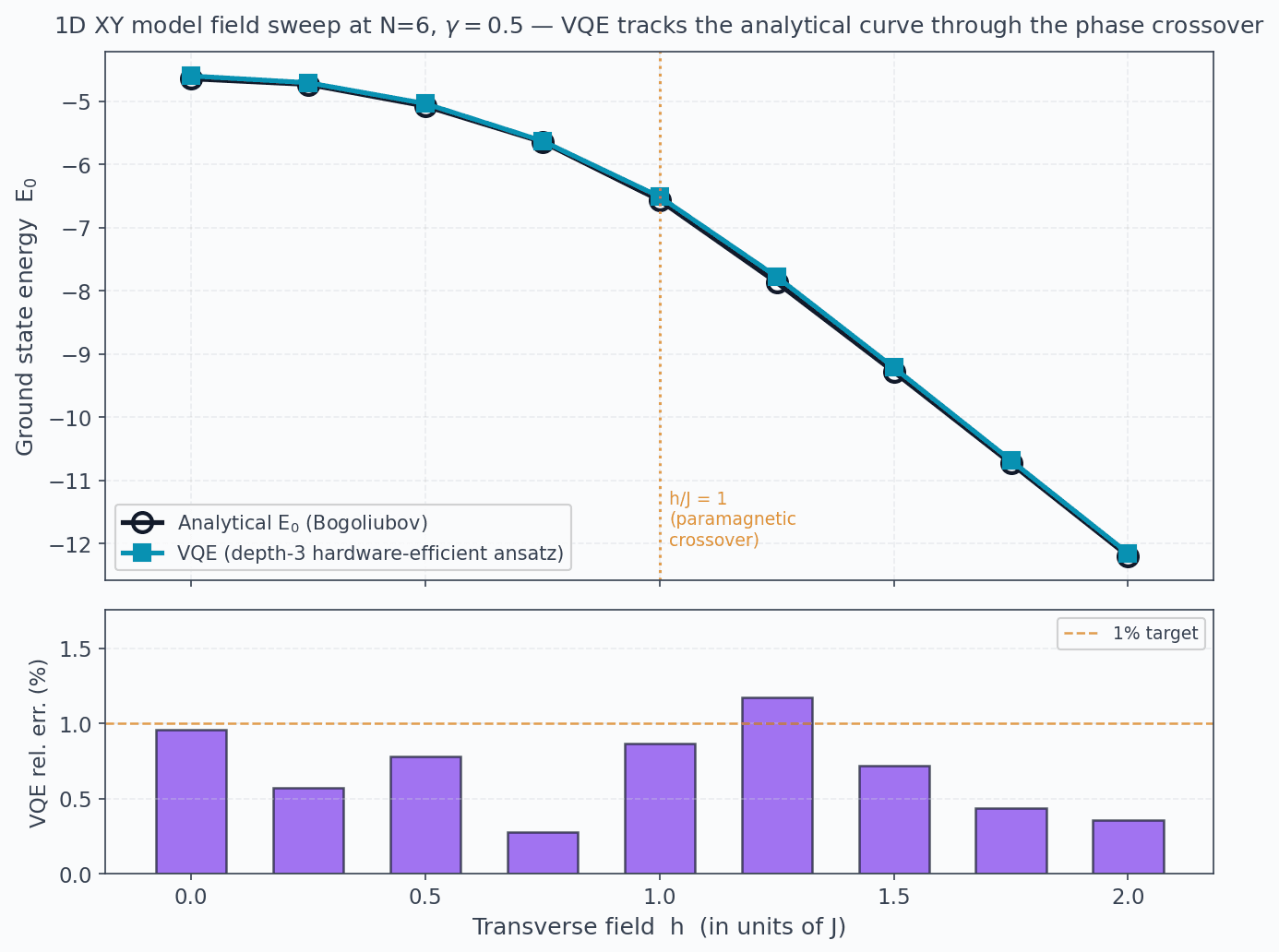
| VQE relative error at N=6 field sweep min 0.28% at h=0.75 | 0.87% |
| VQE relative error at N=8 under paper's 1.5% target | 1.01% |
| Analytical vs full-diag validation PASS at 1e-6 tolerance across N, γ, h | 27/27 |
| Full sweep wall-clock local statevector, no hardware | ~90 s |
| Classical exponential wall above which 8 GB laptop RAM overflows | N ≈ 29 |
[ method ]
How it's built
Hamiltonian: H = -J·Σᵢ[(1+γ)/2·XᵢXᵢ₊₁ + (1-γ)/2·YᵢYᵢ₊₁] - h·Σᵢ Zᵢ with periodic boundary conditions, γ=0.5 anisotropy, N ∈ {4, 6, 8}. Constructed as a Qiskit SparsePauliOp under standard little-endian ordering.
Exact reference: Jordan-Wigner + Bogoliubov gives single-particle energies εₖ = √((h - J·cos k)² + (Jγ·sin k)²), with the ground state energy the minimum over both Neveu-Schwarz (antiperiodic-fermion) and Ramond (periodic-fermion) sectors. VQE: hardware-efficient RealAmplitudes ansatz depth-3, COBYLA optimizer (maxiter=300), 10 random restarts. Statevector simulation, no shot noise.
[ figures ]
Physics visuals
[ mitigation ]
What Qubital's ZNE buys you here
[ references ]
Papers & sources
- "Simulation of the 1D XY Model on a Quantum Computer" (2024).arXivThe reproduction target
- Lieb, E., Schultz, T., Mattis, D. (1961). "Two soluble models of an antiferromagnetic chain." Ann. Phys. 16, 407.Foundational free-fermion analytical solution
- Peruzzo, A., McClean, J., Shadbolt, P., et al. (2014). "A variational eigenvalue solver on a photonic quantum processor." Nat. Commun. 5, 4213.arXivOriginal VQE algorithm
[ what's next ]
Roadmap for this showcase
- Scale to N=12-16 with a symmetry-preserving ansatz (fewer parameters, better convergence)
- Add Richardson ZNE + PEC to the VQE loop — quantify recovery against the exact analytical reference
- Extend to the 2D XY / Heisenberg model on small lattices (2x3, 2x4) for magnetic material applications
- Fermi-Hubbard variant for materials-genome screening of permanent magnets (electric propulsion, radar)
[ request access ]
Want to run this yourself?
The physics-showcases repo is currently private, protecting IP pre-revenue. Physicists, quantum-industry contacts, and investors: reach out and I'll set up a technical walkthrough, call, or Loom.
Request a walkthrough