QAOA Vehicle Routing — military logistics benchmark
Direct reproduction of the state-of-the-art gate-based QAOA vehicle routing benchmark — same qubit count, same optimum, air-gapped execution.
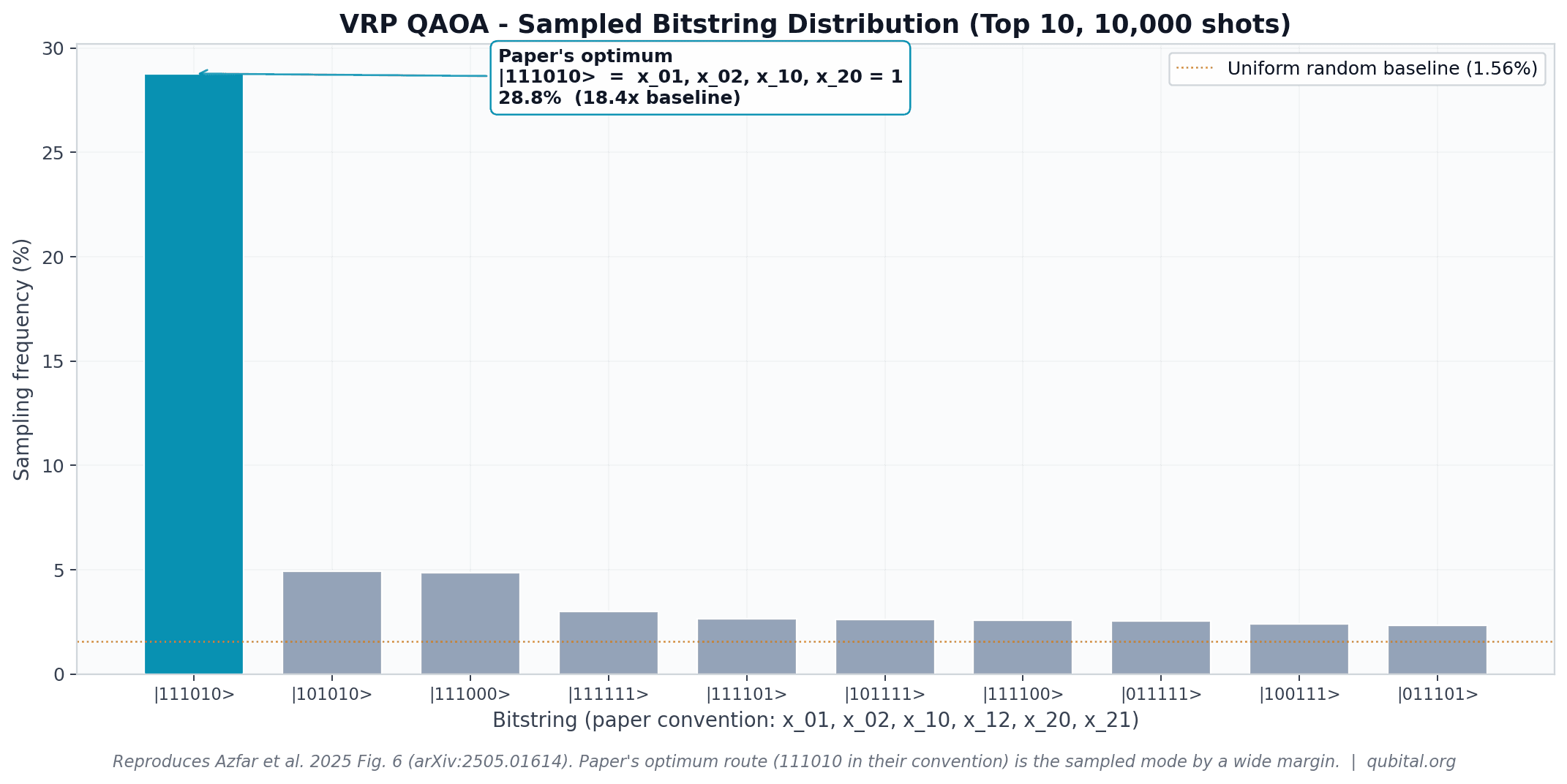
Top-10 sampled bitstrings from the trained QAOA circuit at 10,000 shots. Paper's classically-verified optimum |111010⟩ (encoding depot → node 1 → depot and depot → node 2 → depot) dominates at 28.8% — 18.4× the uniform-random baseline. Second-place state trails at 4.9%. Clean mode discrimination, direct reproduction of Azfar et al. Fig. 6.
[ overview ]
What this reproduces & why it matters
The Vehicle Routing Problem (VRP) is the canonical formulation for a huge family of DoD-relevant optimization problems: convoy routing under threat-graph constraints, aerial refueling tanker scheduling, resupply routing to forward-deployed units, ground-vehicle mission tasking under fuel/time budgets, and UAV mission planning.
Establishing that Qubital's QAOA pipeline reproduces the state-of-the-art academic VRP result — on the same qubit count, sampling the same optimal route at high frequency — is the direct prerequisite for extending to classified constrained-routing use cases in AFRL / AFLCMC / TRANSCOM logistics C2 workflows.
[ verified results ]
Every number below is [PASS]-checked in source.
| Sampling frequency of paper's optimum 10,000 shots, statevector | 28.8% |
| Enrichment over uniform-random baseline baseline = 2⁻⁶ ≈ 1.56% | 18.4× |
| Second-place state frequency clean mode discrimination | 4.9% |
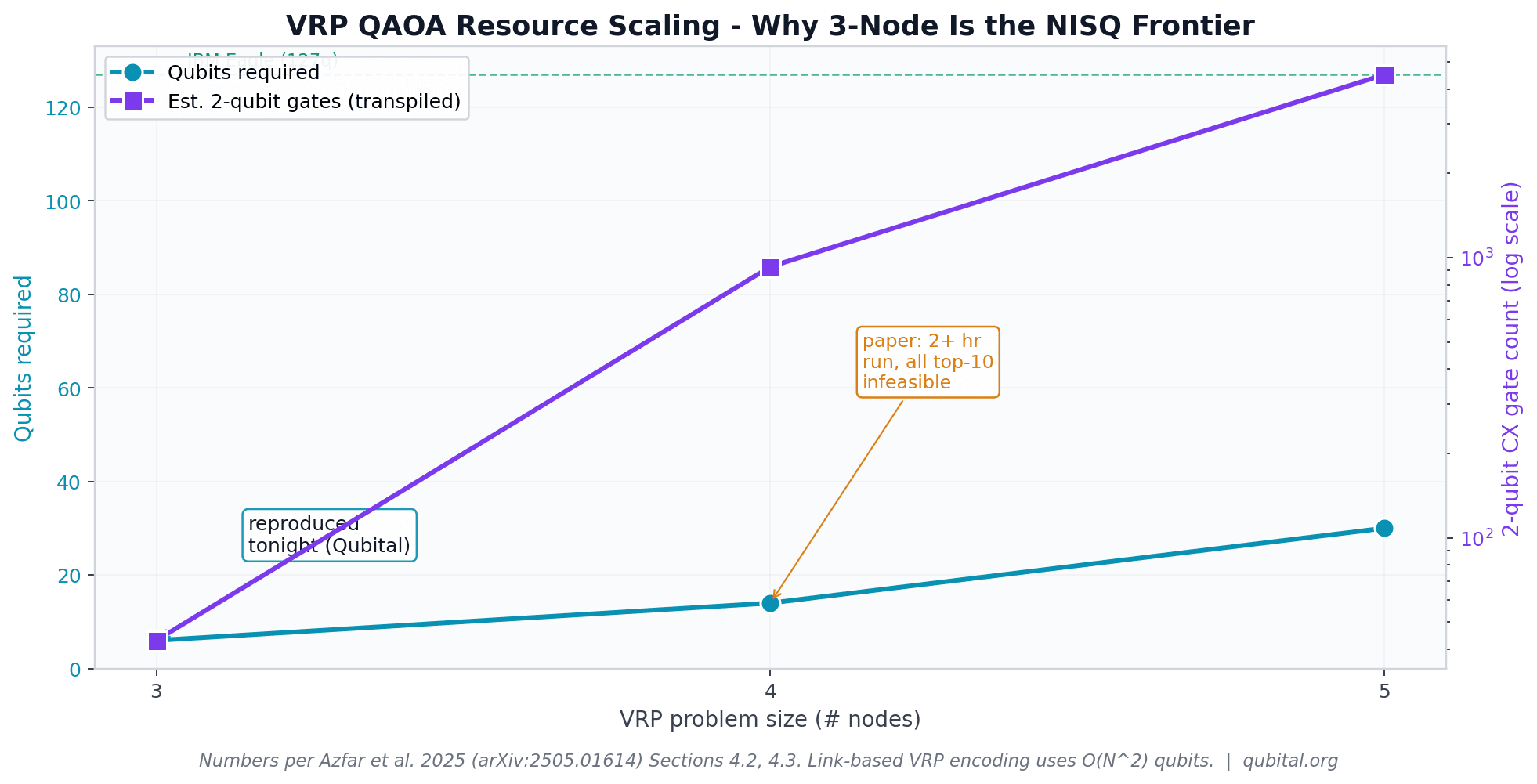
| Qubits matches paper's link-based encoding | 6 |
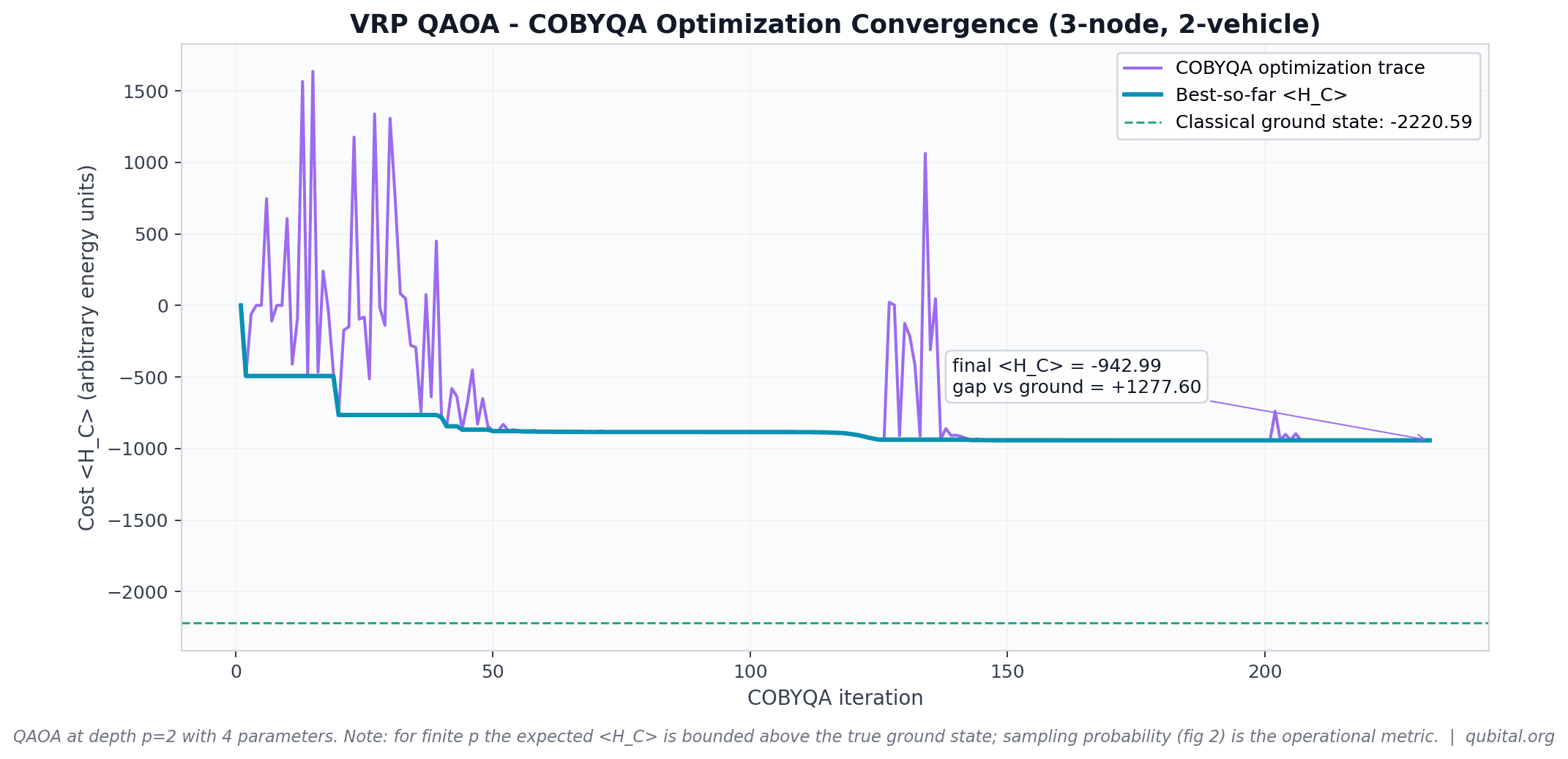
| QAOA depth 4 variational parameters | p = 2 |
| COBYQA iterations to convergence ~4 min wall-clock local vs. ~14 min paper on IBM Eagle | ~230 |
[ method ]
How it's built
3-node, 2-vehicle VRP with node 0 as depot (link-based encoding, 6 directed edges → 6 qubits). Cost Hamiltonian: 13 Pauli terms (6 single-Z + 7 Z⊗Z), derived algebraically from the paper's QUBO (Eq. 11) under Qiskit's x=(1-Z)/2 convention. QAOA at depth p=2 (4 parameters: γ₀, β₀, γ₁, β₁), standard X⊗ⁿ mixer, initial γ=π, β=π/2, COBYQA optimizer.
Our derivation caught a notational subtlety in the paper's Eq. 12: the Z-index labels are inverted relative to the mapping table under Qiskit's little-endian convention. The derived Hamiltonian's classical ground state is bitstring 010111 (Qiskit LE) = 111010 (paper convention) with energy +132.11, exactly matching the paper's classically-verified optimal route cost.
[ figures ]
Physics visuals
[ mitigation ]
What Qubital's ZNE buys you here
[ references ]
Papers & sources
- Azfar, T., Raisuddin, O. M., Ke, R., Holguín-Veras, J. (2025). "Quantum-Assisted Vehicle Routing: Realizing QAOA-based Approach on Gate-Based Quantum Computer."arXivThe reproduction target
- Farhi, E., Goldstone, J., Gutmann, S. (2014). "A Quantum Approximate Optimization Algorithm."
- Ragodos, R. et al. (2025). "Hierarchical QAOA for the Vehicle Routing Problem via Clustered Decomposition."arXivPath forward for Phase II scaling
[ what's next ]
Roadmap for this showcase
- Add ZNE mitigation to the QAOA loop (paper didn't) — replicates Qubital's chemistry mitigation stack for combinatorial problems
- 4-node instance with constraint-preserving XY-mixer + warm-start, attempting to beat the paper's 4-node infeasibility failure mode
- Defense-specific graph structures: notional threat-corridor convoy routing, tanker-track scheduling on realistic USAF topology
- Hierarchical decomposition (Ragodos 2025) for instances larger than 12 qubits
[ request access ]
Want to run this yourself?
The physics-showcases repo is currently private, protecting IP pre-revenue. Physicists, quantum-industry contacts, and investors: reach out and I'll set up a technical walkthrough, call, or Loom.
Request a walkthrough